
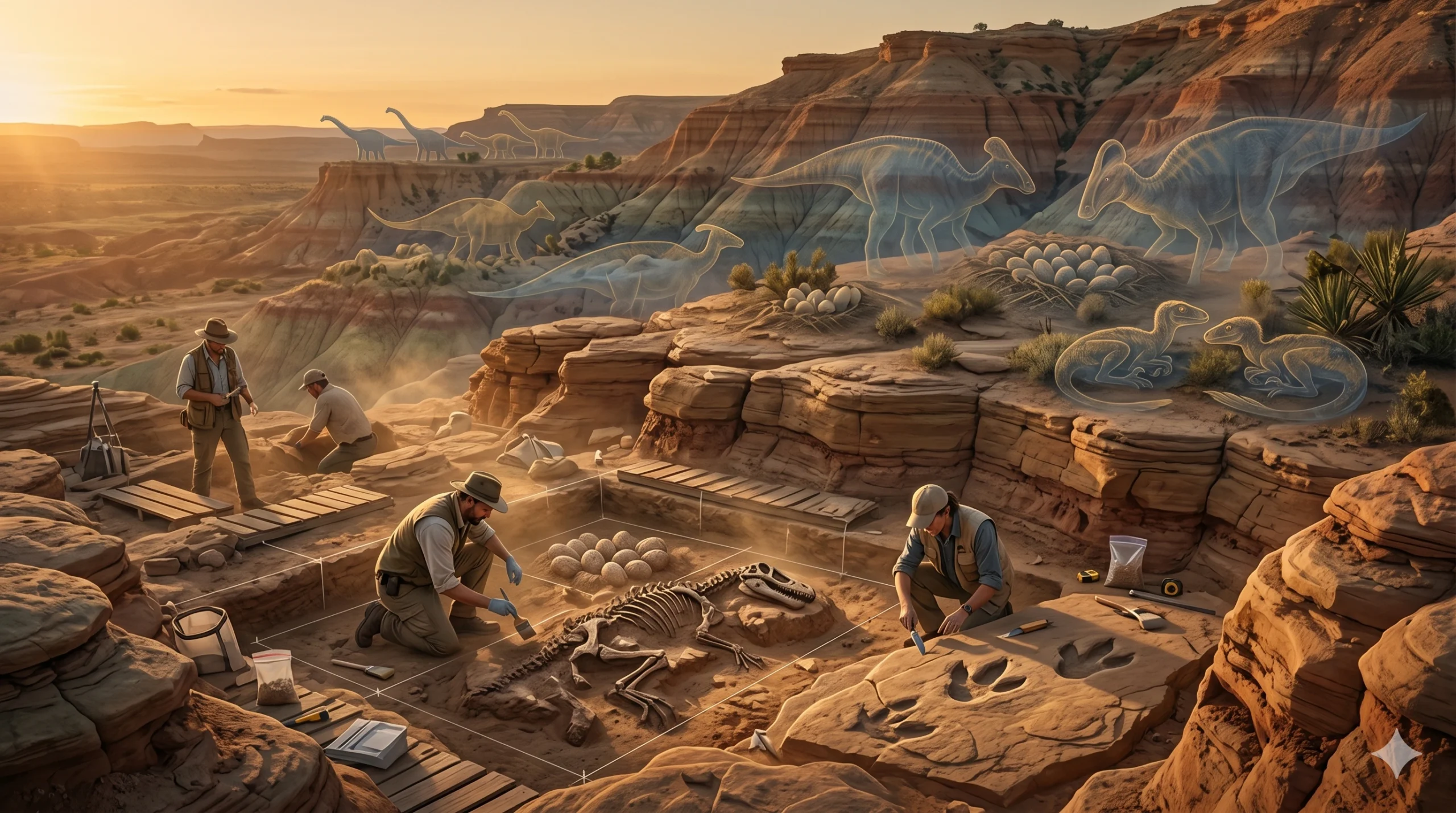
Headlines about T rex blood vessels sound like Jurassic Park science. A 2025 study of Scotty’s fractured rib shows something more precise: a network of vessel-like structures preserved as mineralized casts inside bone — not flexible soft tissue, blood, or DNA.
The study did not recover original soft vessel tissue from Scotty’s rib. It characterized iron-rich mineral casts shaped like vessels inside a fractured T. rex rib. Morphology and location suggest an angiogenic (blood-vessel growth) origin linked to healing, but chemical analysis found mineral replacement — not preserved organic vessel tissue.
What researchers actually found
In July 2025, Scientific Reports published an in situ analysis of vascular structures in a fractured Tyrannosaurus rex rib. The authors describe a network of large vessel-like structures inside bone from specimen RSKM P2523.8, the exceptionally robust Saskatchewan T. rex commonly called Scotty.
Using synchrotron micro-computed tomography, the team visualized those structures inside the rib without cutting them free first. Chemical microprobing with synchrotron X-ray fluorescence and X-ray absorption spectroscopy, plus optical and electron microscopy, then tested what the structures are made of.
The key result is morphological and chemical at once: the structures look like vessels, sit in a fractured healing region, and chemically behave as permineralized casts — mineral fillings that preserve shape after original soft tissue is gone.
Scotty’s rib and the fracture
RSKM P2523.8 is held by the Royal Saskatchewan Museum. The skeleton was found in 1991 near Eastend, Saskatchewan, in the Late Cretaceous Frenchman Formation. The paper notes that Scotty is currently estimated to be among the largest recovered T. rex specimens, with a large fraction of the skeleton known — an estimate, not an uncontested absolute ranking for all time.
The analyzed material is a rib showing a healed fracture. Institutional coverage from the Canadian Light Source explains that synchrotron X-rays let researchers map both bone and internal vessel-like structures in 3D while leaving the fossil intact.
A fracture does not by itself prove how the injury happened. Popular explanations such as combat with another dinosaur remain speculative unless the study itself demonstrates that cause. What the paper supports more carefully is evidence of healing biology recorded in bone structure.
How synchrotron imaging worked
Synchrotron light is intense, tunable X-ray radiation. In this study it enabled:
- Synchrotron micro-CT — three-dimensional imaging of vessel-like networks still inside the rib.
- X-ray fluorescence mapping — which elements are concentrated in those structures.
- X-ray absorption near-edge structure (XANES) — chemical state information, including iron oxidation state.
Those methods matter because earlier soft-tissue debates often relied on dissolving mineral matrix or examining extracted residues. Here the researchers emphasize in situ visualization: seeing the network where it sits in the bone, then matching morphology to chemistry.
What the structures are made of
According to the paper, the vessel-like structures are composed of pyrite partially oxidized to goethite or hematite, preserved in two distinct layers as permineralized casts.
In plain language: minerals replaced or infilled the spaces once occupied by soft anatomy. The cast can keep a vessel-like shape even when no original soft tissue remains to sample.
The chemical work found iron in the Fe3+ state associated with the structures, plus minor elements such as nickel, lead, zinc, potassium, and silicon. Critically, the authors report no indications of organic preservation in these vessels — carbon was not present in the structures under the techniques used.
| Observation | What it means | What it does not mean |
|---|---|---|
| Vessel-like morphology in 3D | Shape consistent with a vascular network | That flexible, living vessel tissue is still present |
| Pyrite → goethite/hematite layers | Mineral replacement / cast preservation | That blood itself was chemically preserved |
| No carbon detected in the structures | Supports mineral casts over organic tissue | That all dinosaur soft-tissue claims everywhere are false |
| Structures concentrated at a fracture | Consistent with angiogenic healing response | Proof of a specific cause of injury |
What this suggests about bone healing
Because the vessel-like network appears in the fractured region, the authors interpret an angiogenic origin: new vessel growth associated with bone healing and regrowth.
That is a morphological inference. It is stronger than saying vessels remained biologically fresh across deep time, and weaker than claiming a fully reconstructed healing physiology. The paper presents bone healing as a promising target for future multi-technique work on dinosaur healing potential — an invitation to more research, not a finished medical biography of Scotty.
Careful wording
Prefer phrases like vessel-like structures, mineralized vascular casts, and structures interpreted as remnants of the original vascular network. Do not claim literal soft vessels remained biologically intact across Late Cretaceous deep time — this paper does not support that.
Why this is not original vessel tissue
Older popular articles often mix several different discoveries: demineralized flexible residues from other specimens, protein fragment debates, and mineralized vessel shapes. Those topics are related but not identical.
For Scotty’s rib study, the controlling conclusion is clear:
- the structures are vessel-like;
- they are preserved as permineralized mineral casts;
- no original soft tissues were recovered with the techniques used;
- chemistry supports mineral replacement rather than preserved organic vessel walls.
Iron-rich minerals can create dramatic vessel-shaped fossils. Dramatic shape is not the same as preserved blood, cells, or usable biological material.
Could dinosaur DNA still exist?
No. This study does not report DNA, viable cells, or clonable genomes from Scotty’s rib. DNA is far less stable on deep-time scales than durable mineral casts or even some protein fragments discussed in other research programs.
Jurassic Park remains fiction. Scientists may recover minerals, pigments, or rare molecular traces under exceptional conditions. Recovering a complete T. rex genome from Late Cretaceous bone is not supported by this paper — and is not a realistic reading of these vessel-like casts.
Knowledge check
Evidence ladder
From headline to mineral cast
How to climb from “T. rex blood” headlines to what the methods actually show.
-
Headline
Blood vessels?Popular wording implies soft, living tissue.
-
Specimen
Scotty ribA fractured rib with internal vessel-like structures.
-
Imaging
Synchrotron CT3D structure mapped without destroying the fossil.
-
Chemistry
Mineral mapComposition matches mineral replacement casts.
-
Claim
Careful conclusionShape from former biology; material is mineral now.
T rex blood vessels FAQ
Did scientists find soft, original T. rex vessels in this rib?
No. They found vessel-like structures preserved as mineralized (permineralized) casts inside Scotty’s fractured rib.
Was any original soft tissue recovered from these structures?
Not with the techniques used in the 2025 Scientific Reports study. The authors state that no original soft tissues were recovered and that carbon was not present in the vessels.
What minerals formed the casts?
Pyrite partially oxidized to goethite or hematite, in two distinct layers.
Does this prove Scotty fought another dinosaur?
No. The rib shows a healed fracture and vessel-like structures consistent with healing. Specific injury stories remain speculative unless independently demonstrated.
Is Scotty the largest T. rex ever found?
The paper describes RSKM P2523.8 as currently estimated to be the largest recovered T. rex specimen. Treat that as an estimate tied to available comparative data, not an absolute forever-claim.
Sources and references
- Mitchell et al. (2025). In situ analysis of vascular structures in fractured Tyrannosaurus rex rib. Scientific Reports. DOI: 10.1038/s41598-025-06981-z
- PubMed record for Mitchell et al. 2025
- Canadian Light Source / University of Regina institutional summary of the Scotty rib synchrotron study
- Mindivr — The Age of Dinosaurs (DEV)
- Mindivr — Frozen Dinosaurs in Antarctica (DEV)
Editorial note: The public production page mixed older soft-tissue storytelling with overstated vessel-survival framing. This DEV migration is controlled by Mitchell et al. 2025 on Scotty (RSKM P2523.8): mineralized vessel-like casts in a healing rib, not original soft vessel tissue.
Join the conversation
Share a thoughtful question, correction, or insight. Keep it civil and evidence-aware.