
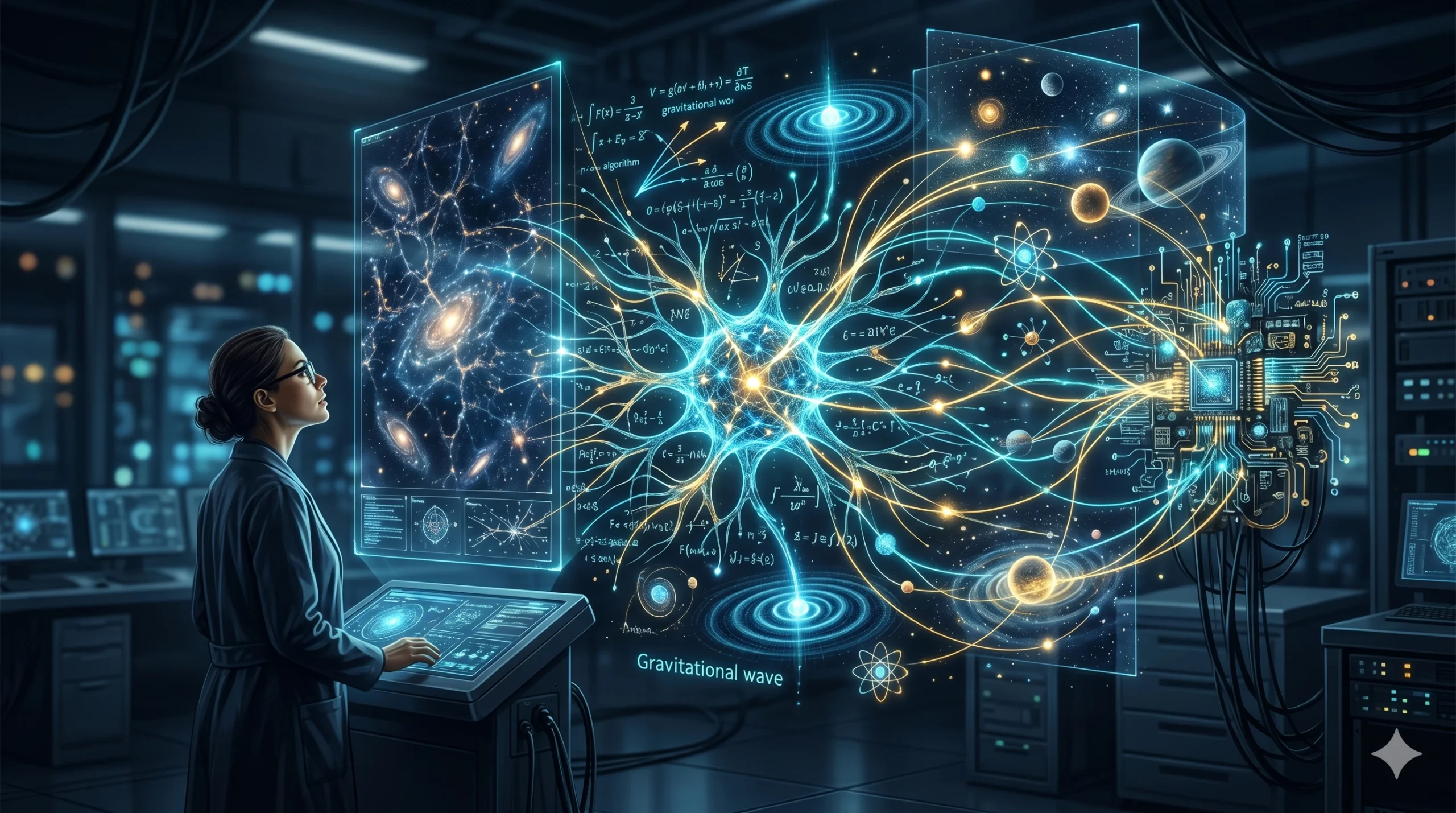
Can AI discover new laws of physics? The honest answer is: maybe — but not in the magical way people imagine.
AI can find hidden patterns, compress enormous datasets and suggest equations. But a pattern is not automatically
a law of nature.
Physics has always been a search for invisible structure. Apples fall. Planets orbit. Light bends. Atoms emit
energy in strange steps. Behind all of these observations, scientists search for rules that are simple enough
to write down, strong enough to predict reality and deep enough to survive repeated testing.
Artificial intelligence changes this search because it can explore data at a scale human minds cannot. A human
physicist may look for elegant relationships between a few variables. An AI model can scan millions of possible
combinations, detect non-obvious correlations and generate candidate equations faster than any person could
manually test.
But this creates a new problem. If AI produces a formula that predicts an experiment beautifully, has it discovered
a law? Or has it simply found a clever mathematical shortcut? That difference matters. Science is not just curve-fitting.
A real law of physics must explain, generalize and survive contact with reality outside the data that created it.
AI may help discover new physics, but discovery does not end when a model finds a pattern. It begins when that
pattern becomes testable, interpretable and connected to the physical world.
This is the real question: not whether AI can calculate, but whether AI can help science move from data to meaning.
That journey — from measurement to pattern, from pattern to equation, from equation to theory — is where the future
of physics may become stranger and more powerful.
What counts as a law of physics?
A law of physics is not just a sentence that sounds scientific. It is a compact description of a regular pattern
in nature. Newton’s laws describe motion. Maxwell’s equations describe electricity, magnetism and light.
Einstein’s field equations describe gravity as geometry. Quantum mechanics describes how matter and energy behave
at small scales.
What makes these laws powerful is not only that they match known data. They also reach beyond the original data.
A good physical law compresses many observations into a small structure. It predicts new cases. It reveals why
different phenomena belong together. It can be tested by people who did not invent it.
This is why discovering a law is much harder than detecting a pattern. A pattern can be accidental. A pattern can
exist only inside one dataset. A pattern can be caused by measurement bias. A pattern can disappear when the experiment
changes. A law must be stronger than that.
For AI, this distinction is crucial. Machine learning is excellent at discovering patterns. It can predict protein
structures, classify galaxies, simulate materials and detect anomalies in particle physics data. But a law of physics
needs something more: a bridge between prediction and explanation.
A pattern says, “This usually happens.” A law says, “This happens because reality has this structure.”
How AI finds hidden patterns in physics
AI is powerful in physics because modern science produces more data than human intuition can comfortably hold.
Particle detectors generate immense streams of collision events. Telescopes map huge regions of the sky.
Climate models, materials databases and fluid simulations create multidimensional landscapes of numbers.
A human scientist might inspect a graph and ask whether a relationship looks linear, curved or periodic. AI can
search far larger spaces. It can compare thousands of variables, compress complex patterns into latent structures
and detect regularities that are too subtle for visual inspection.
Some systems use symbolic regression, a technique that tries to find mathematical expressions that fit data.
Unlike a black-box neural network, symbolic regression can produce equations that humans can inspect. This matters
because physics loves compact expressions. A mysterious black box may predict well, but an equation can be read,
tested and connected to known principles.
Another approach is sparse discovery. Many physical systems may look complicated, but their governing equations
often depend on a small number of important terms. Sparse methods try to identify the few terms that matter most.
Instead of building a huge model with thousands of parameters, they search for a simpler rule hidden inside the noise.
Raw Data
Step 1:
Measurements arrive from experiments, simulations or observations.
This is where AI becomes exciting. It can act like a searchlight over possibility space. It does not get tired.
It does not care whether a candidate equation looks familiar. It can suggest relationships that humans might not
have tried because they looked unintuitive or mathematically awkward.
But physics is not only about finding any formula that works. It is about finding the right level of simplicity.
Too simple, and the model misses reality. Too complex, and it becomes an overfitted machine that remembers the
data without understanding the world.
Why prediction is not the same as understanding
Imagine an AI trained on thousands of videos of falling objects. It may learn to predict where an object will be
after one second, two seconds or three seconds. That is impressive. But does the AI understand gravity?
The answer depends on what “understand” means. If understanding means producing accurate outputs, then many AI
systems already look impressive. If understanding means knowing why a relationship holds, how it connects to other
laws and where it will fail, then the answer becomes much harder.
A black-box model can be useful even when it is not interpretable. Engineers and scientists often care about
prediction. If a model predicts a material’s stability, a star’s behavior or a plasma instability, that can save
time and guide experiments. But physics also wants explanation. It wants the hidden mechanism.
This is the tension at the heart of AI science. AI can outperform humans at pattern detection while still failing
to provide a human-readable theory. It can say, “This will happen,” without clearly saying, “This is why it happens.”
| Level | What AI can do | Why it matters |
|---|---|---|
| Prediction | Forecast outcomes from data. | Useful for experiments, simulations and screening. |
| Pattern discovery | Detect hidden relationships between variables. | Can reveal clues humans may miss. |
| Equation search | Suggest compact mathematical expressions. | Moves closer to interpretable physics. |
| Scientific law | Requires testing, interpretation and generalization. | This is where human science still matters deeply. |
In other words, AI can help build the ladder from data to theory, but it does not automatically climb the entire
ladder alone. A law of physics is not only a statistical artifact. It is a statement about how nature behaves.
Where AI is already helping science
AI is already changing scientific discovery, even if it has not yet produced a universally accepted new fundamental
law of physics on its own. The strongest examples are not magic breakthroughs. They are accelerators: tools that
make scientists faster, broader and more precise.
1. Discovering equations from data
Sparse identification methods such as SINDy aim to discover governing equations from measurement data. The key idea
is that many physical systems can be represented by only a few important terms when written in the right mathematical
language. Instead of guessing every possible equation by hand, the algorithm searches for a compact set of terms that
explains the observed dynamics.
2. Symbolic regression and AI Feynman
Symbolic regression tries to find equations that match data while remaining readable. AI Feynman is one famous example
of this direction. It combines neural-network fitting with physics-inspired techniques, searching for compact formulas
that can reproduce relationships from known physics problems.
3. Materials discovery
AI is also transforming materials science. Deep learning systems can predict stable crystal structures and screen enormous
spaces of possible materials. This is not the same as discovering a fundamental law of physics, but it shows how AI can
guide real scientific work by narrowing the search for useful structures.
4. Particle physics and anomaly detection
In particle physics, AI can help classify collision events, reduce noise and search for anomalies. This is important because
new physics may first appear as a subtle deviation from expected patterns. AI can be used as a detector of the unexpected,
a tool that points scientists toward places where existing theories may be incomplete.
5. Simulation acceleration
Physics simulations can be expensive. AI surrogate models can approximate parts of simulations much faster, allowing scientists
to explore more scenarios. Again, this does not replace theory, but it changes the scale of what can be tested.
AI has already accelerated discovery in science. The bigger question is whether it can move from helping discovery
to creating new fundamental theories that humans can verify and understand.
The human part AI still cannot replace
The popular fear is that AI will replace scientists. The more realistic possibility is stranger: AI may change what
scientists do. Instead of manually searching through every possible model, scientists may increasingly design questions,
judge candidate theories and decide which patterns are physically meaningful.
Human physicists bring context. They know which assumptions are suspicious, which variables are measurable, which
simplifications are dangerous and which predictions are worth testing. They also bring taste — not artistic taste,
but scientific taste: the preference for explanations that are simple, deep and connected to existing knowledge without
being trapped by it.
AI can propose. Humans still have to interrogate. Does this formula make dimensional sense? Does it violate conservation
laws? Does it work outside the training data? Can another lab reproduce it? Does it connect to known principles, or does
it merely imitate the dataset?
This is why AI discovery may become a partnership. The AI searches. The scientist questions. The experiment decides.
Reality gets the final vote.
What future physics may look like with AI
Future physics may look less like a lone genius writing equations on a chalkboard and more like a loop between machines,
humans and experiments. AI systems may generate candidate models. Robotic labs may test them. Human scientists may interpret
the results, refine the assumptions and decide which paths deserve deeper investigation.
This does not make human imagination obsolete. It may make imagination more important. When AI can generate thousands of
possible models, the rare skill becomes knowing which questions matter. The scientist becomes less like a calculator and
more like a guide through a jungle of possible explanations.
The most exciting possibility is not that AI discovers physics alone. It is that AI helps us notice where our current
theories are incomplete. It may find cracks in models, strange regularities in data or unexpected bridges between fields.
A future law of physics may begin as an AI-generated clue that a human did not know how to ask for.
AI may not replace the physicist. It may become the strange new telescope — not pointed at the sky, but pointed at
the hidden structure inside data.
So, can AI discover new laws of physics? Maybe. But the better answer is this: AI can help reveal candidate patterns that
are too complex, too subtle or too vast for human intuition alone. Whether those patterns become laws depends on the old
scientific ritual: explanation, experiment, replication and doubt.
Nature does not care whether a theory was proposed by a human, a machine or a collaboration between both. Nature only asks:
does it survive reality?
Knowledge check
Discovery ladder
From data pile to candidate law
How an AI-assisted physics loop typically climbs — with humans in the verification seats.
-
Data
CollectSensors and simulations produce large datasets.
-
Compress
RepresentModels learn compact features or surrogates.
-
Propose
HypothesizeSymbolic or neural methods suggest candidate relations.
-
Test
FalsifyHumans and experiments try to break the candidate.
-
Theory
IntegrateSurviving ideas must fit broader physical frameworks.
FAQ: AI and new laws of physics
Can AI discover new laws of physics by itself?
AI can discover patterns and suggest equations, but a true law of physics needs interpretation, testing and independent
validation. AI alone is not enough unless the result survives scientific scrutiny.
What is symbolic regression?
Symbolic regression is a method that searches for mathematical expressions that fit data. It is important because it can
produce readable equations instead of only black-box predictions.
Is prediction the same as understanding?
No. Prediction can be useful without being explanatory. Physics usually wants more than accurate outputs; it wants compact,
general and testable explanations.
Will AI replace physicists?
More likely, AI will change the role of physicists. Scientists may spend more time designing questions, judging models and
testing AI-generated hypotheses.
-
Brunton, S. L., Proctor, J. L., & Kutz, J. N. —
Discovering governing equations from data by sparse identification of nonlinear dynamical systems
, PNAS. -
Udrescu, S.-M., & Tegmark, M. —
AI Feynman: A physics-inspired method for symbolic regression
. -
Merchant, A. et al. —
Scaling deep learning for materials discovery
, Nature. -
Google DeepMind —
Millions of new materials discovered with deep learning
. -
Nobel Prize —
The Nobel Prize in Physics 2024 press release
. -
Nature Computational Science —
Discovering physical laws with parallel symbolic enumeration
.
Editorial note: This article was created through Mindivr’s editorial process: topic research, source review,
visual explanation design and human editing. If you spot an error, please use the contact page.
How Newton & Einstein Saw What Others Missed
Explore how two minds saw hidden patterns inside ordinary reality.
Quantum Entanglement Without the Mysticism
A clear guide to one of physics’ strangest real patterns.
What Is Dark Matter?
The invisible mass shaping galaxies and cosmic structure.
Get one science mystery and one puzzle every week.
Join Mindivr for interactive science articles, visual explanations and curiosity-first science stories.
If this article made you curious, support the next one.
Mindivr is built for premium visual science explanations. Your support helps create more interactive articles,
diagrams and science puzzles.
Join the conversation
Share a thoughtful question, correction, or insight. Keep it civil and evidence-aware.