
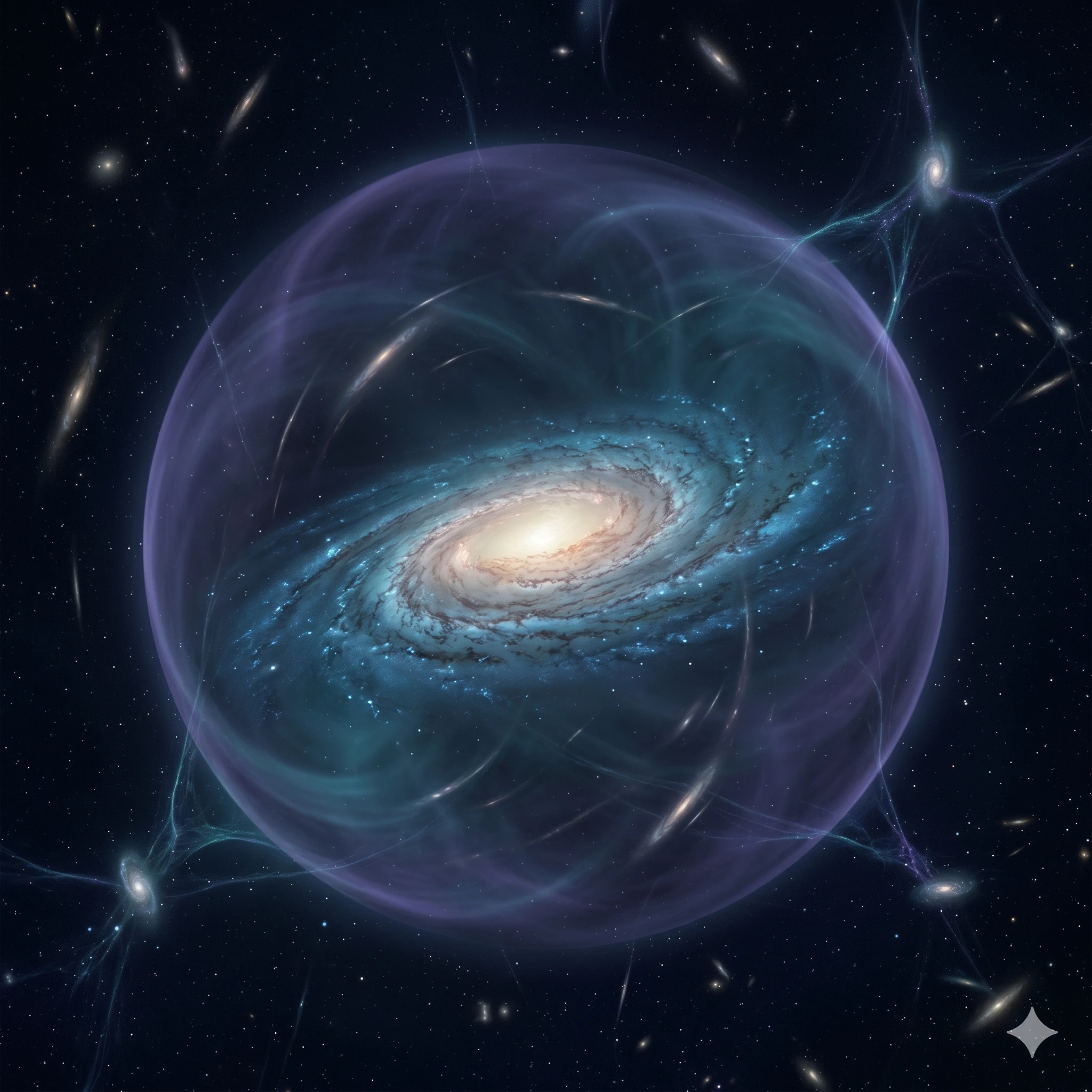
What is dark matter? It is an invisible form of matter that does not emit light, but whose gravity helps hold galaxies together and shape the largest structures in the universe.
Dark matter is one of the strangest ideas in modern cosmology because it begins with an absence. We do not see it directly.
It does not glow like stars, reflect light like planets or form bright clouds like ordinary gas. And yet, when astronomers
measure how galaxies move, how clusters bend light and how cosmic structure grows, something invisible appears to be adding
gravity.
The name “dark matter” can sound like science fiction, but the idea is not based on imagination. It is based on repeated
gravitational evidence. Stars in galaxies move as if more mass exists than telescopes can see. Galaxy clusters hold together
as if they contain extra invisible mass. Light from distant galaxies bends around massive foreground objects in ways that reveal
unseen gravitational structure.
This is why the question “what is dark matter?” matters so much. It is not simply asking what the universe contains. It is
asking why the visible universe seems to be only a small part of the full gravitational story.
Dark matter is not “dark” because it is evil, mysterious magic or black-colored dust. It is called dark because it does not interact with light in the normal visible way.
Scientists do not yet know what dark matter is made of. That is the mystery. But they have strong reasons to think something
invisible is there. In a sense, dark matter is like wind: you do not see the wind itself, but you see leaves move, waves shift
and clouds change shape. With dark matter, we do not see the substance directly — we see gravity behaving as if it is there.
How do we know dark matter exists?
The evidence for dark matter comes from gravity. Gravity is the universe’s detective. Even when something does not shine,
its mass can still affect the motion of other things. If stars, galaxies and light behave as if extra mass exists, scientists
must explain where that gravity comes from.
One major clue comes from galaxy rotation. In a simple expectation, stars farther from a galaxy’s center should orbit more
slowly if most of the mass is concentrated in the bright central region. But many galaxies rotate in a way that suggests a large
invisible halo of matter surrounds them.
Another clue comes from galaxy clusters. Clusters are enormous collections of galaxies, hot gas and dark matter. The visible
matter alone often cannot explain the gravitational behavior of the cluster. Something else appears to contribute mass.
The numbers vary slightly depending on mission data and cosmological model, but the broad picture is clear: ordinary matter
— atoms, stars, planets, dust, gas and people — is not the dominant mass-energy component of the cosmos. Dark matter is a much
larger gravitational ingredient than ordinary matter.
We infer dark matter the way we infer an invisible hand pushing a swing: not because we see the hand, but because the motion demands a cause.
Why galaxies need invisible mass
Galaxies are not just glowing spirals in space. They are gravitational systems. A spiral galaxy contains stars, gas, dust,
black holes, magnetic fields and a huge amount of invisible structure. Without enough gravity, fast-moving stars in the outer
regions would not orbit the way they do.
Dark matter helps explain why galaxies remain organized. In the standard picture, a galaxy sits inside a dark matter halo —
a large, roughly spherical region of invisible matter extending far beyond the bright disk. The stars and gas we see are like
lights inside a much larger gravitational scaffold.
This does not mean dark matter is “holding galaxies together” like glue in a simple mechanical sense. It means the galaxy’s
gravitational field appears stronger and more extended than visible matter alone can explain.
What is dark matter doing in a galaxy? In the current model, it provides much of the gravitational architecture. It influences
how galaxies form, how they rotate and how they gather ordinary matter over billions of years.
The bright galaxy is only the visible part. The dark matter halo may be the larger invisible structure shaping how that galaxy moves.
Gravitational lensing: seeing the invisible
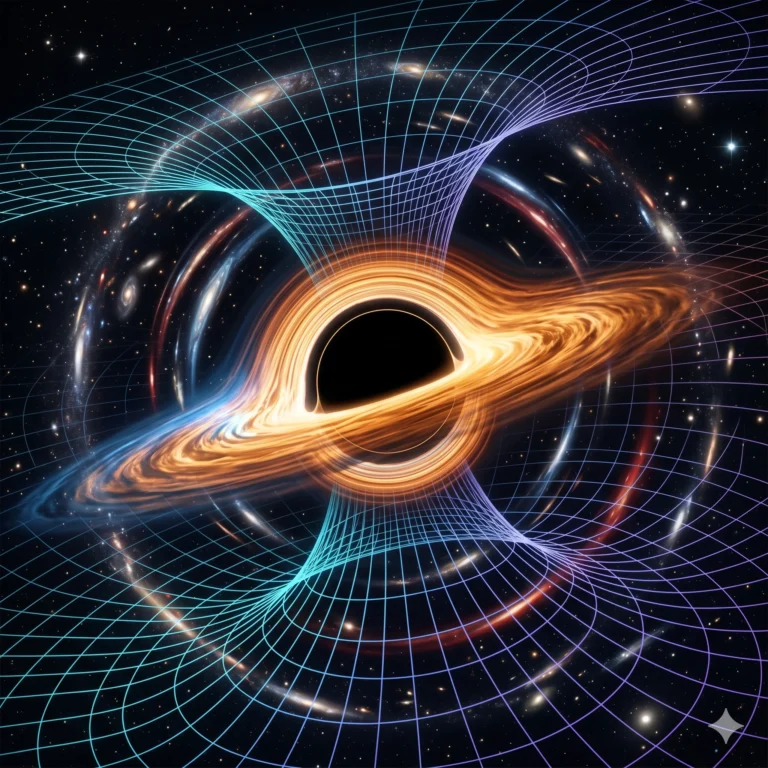
One of the most elegant clues for dark matter is gravitational lensing. According to general relativity, mass bends spacetime,
and that bending changes the path of light. If a massive galaxy cluster sits between us and a more distant galaxy, the cluster
can distort, stretch or magnify the background galaxy’s light.
This gives astronomers a way to map mass, even when that mass does not shine. If the lensing pattern shows more gravity than
visible stars and gas can provide, dark matter becomes part of the explanation.
NASA describes gravitational lensing as one of the ways scientists study dark matter: dark matter does not interact with light
directly, but its gravity can bend light from distant galaxies. That makes lensing a cosmic x-ray of invisible mass.
Galaxy Rotation
Clue 1:
Stars orbit galaxies as if extra invisible mass is present.
This is why dark matter is not merely a patch for one odd galaxy. The evidence appears across many scales: individual galaxies,
galaxy clusters, background light distortion and the large-scale structure of the universe.
Dark matter and the cosmic web
On the largest scales, the universe looks like a web. Galaxies are not scattered randomly like dust. They gather along filaments,
walls and clusters, leaving enormous voids between them. This structure is called the cosmic web.
Dark matter is central to this picture. Tiny density variations in the early universe grew under gravity. Regions with slightly
more matter attracted more matter. Over billions of years, dark matter helped form a gravitational scaffolding where ordinary
gas could fall in, cool and form galaxies.
NASA describes the large-scale cosmic web as a structure made largely of dark matter, while ESA’s Euclid mission is designed
to map billions of galaxies and explore how cosmic structure formed across time. The goal is not only to make beautiful maps,
but to understand how gravity built the visible universe from invisible structure.
| Scale | What we observe | Dark matter role |
|---|---|---|
| Galaxy | Stars orbit faster than visible mass predicts. | Invisible halo adds gravitational mass. |
| Galaxy cluster | Clusters bend light and hold hot gas. | Extra mass explains gravitational strength. |
| Cosmic web | Galaxies form filaments and voids. | Dark matter acts as gravitational scaffolding. |
| Early universe | CMB patterns encode matter content. | Cosmological models require dark matter. |
What is dark matter in this cosmic-web view? It is the invisible framework around which visible matter organized itself.
Without it, the universe would likely not have formed galaxies and clusters in the way we observe today.
What could dark matter be?
This is where the mystery becomes sharper. Scientists have strong gravitational evidence for dark matter, but they have not
yet identified the particle or substance responsible. Several candidate ideas have been proposed.
One broad category is new particles beyond the Standard Model of particle physics. These hypothetical particles would have
mass, interact gravitationally and interact very weakly — or perhaps not at all — with light. That would make them difficult
to detect directly.
Another possibility involves very light particles such as axions, originally proposed for a different physics problem but now
studied as dark matter candidates. There are also alternative gravity theories that attempt to explain observations without
adding invisible matter, but the dominant cosmological model still uses dark matter as a major ingredient.
Scientists have strong evidence that something behaves like dark matter. They do not yet know exactly what that something is.
That uncertainty is not a weakness of science. It is science doing its job. The evidence points to a missing ingredient,
and the next step is to identify it.
What dark matter is not
Dark matter is often misunderstood, partly because the name sounds dramatic. It is not antimatter. Antimatter is a real form
of matter made of antiparticles, and when it meets ordinary matter, it can annihilate and release energy. Dark matter does
not behave like that in the evidence we observe.
Dark matter is also not the same as dark energy. Dark matter pulls gravitationally and helps structure form. Dark energy is
associated with the accelerated expansion of the universe. They are both “dark” because they are not directly visible like
stars, but they are very different ideas.
Dark matter is not simply black holes, dead stars or hidden planets. Ordinary objects that do not shine can contribute some
unseen mass, but observations indicate that dark matter is not just normal atomic matter hiding in darkness.
| Confusion | Reality |
|---|---|
| Dark matter is antimatter | No. Antimatter and dark matter are different concepts. |
| Dark matter is dark energy | No. Dark matter helps structure form; dark energy drives accelerated expansion. |
| Dark matter is just black holes | Black holes may contribute mass, but they do not explain all dark matter evidence. |
| Dark matter is magic | No. It is a scientific placeholder for an invisible gravitational component still under investigation. |
Why dark matter matters
Dark matter matters because it changes the scale of what we think reality is. The universe we see is not the whole story.
Stars, planets, nebulae and galaxies are luminous markers inside a much larger gravitational architecture.
If dark matter exists as a new particle, discovering it would connect cosmology with particle physics in a profound way.
The structure of galaxies would become evidence for physics beyond the particles we already know. The night sky would become
a laboratory for invisible matter.
If the answer turns out to be a modification of gravity, that would be equally revolutionary. It would mean our understanding
of gravity needs to change on cosmic scales. Either way, the mystery of dark matter is not small. It sits at the intersection
of galaxies, quantum physics, relativity and the origin of cosmic structure.
Dark matter is the universe’s invisible architecture: not seen directly, but revealed by the way everything visible moves.
What is dark matter? The most honest answer is both simple and unfinished: it is the invisible gravitational ingredient
shaping galaxies and cosmic structure, but its true identity remains one of science’s greatest open questions.
Knowledge check
Clue ladder
How dark-matter clues stack
From a single galaxy’s odd motion to cosmology-scale patterns.
-
One galaxy
Rotation curveStars move too fast for visible mass alone.
-
Clusters
Cluster dynamicsMember galaxies and hot gas imply extra mass.
-
Lensing
Bent lightGravity warps background galaxies more than visible mass predicts.
-
CMB
Early universeCosmic microwave patterns fit models with a dark-matter component.
-
Open
Particle huntLabs and telescopes still search for what it is made of.
FAQ: What is dark matter?
What is dark matter in simple terms?
Dark matter is invisible matter inferred from gravity. It does not emit or reflect light, but its gravitational effects shape galaxies and cosmic structure.
Can we see dark matter?
Not directly with ordinary telescopes. Scientists infer dark matter from effects such as galaxy rotation, galaxy cluster behavior and gravitational lensing.
Is dark matter the same as dark energy?
No. Dark matter behaves like invisible mass that pulls through gravity. Dark energy is associated with the accelerated expansion of the universe.
Do scientists know what dark matter is made of?
Not yet. Many candidate particles and ideas exist, but dark matter has not been directly identified.
-
NASA Science —
Dark Matter
. -
NASA WMAP —
WMAP Overview
. -
ESA Science & Technology —
What is dark matter?
. -
ESA —
The dark Universe
. -
NASA Hubble —
Mapping the Cosmic Web
. -
ESA Euclid —
Euclid mission overview
.
Editorial note: This article was created through Mindivr’s editorial process: topic research, source review,
visual explanation design and human editing. If you spot an error, please use the contact page.
The Edge of the Observable Universe
Why the universe has an observable horizon, but not necessarily a wall.
Solar System Explorer
Explore gravity, planets, orbits and your weight on other worlds.
Can AI Discover New Laws of Physics?
How machine learning may help reveal hidden physical patterns.
Get one science mystery and one puzzle every week.
Join Mindivr for interactive science articles, visual explanations and curiosity-first science stories.
If this article made you curious, support the next one.
Mindivr is built for premium visual science explanations. Your support helps create more interactive articles,
diagrams and science puzzles.

Join the conversation
Share a thoughtful question, correction, or insight. Keep it civil and evidence-aware.