
Solar System Explorer is an interactive Mindivr guide to gravity, planets, orbital motion and the physics
that holds our cosmic neighborhood together.
The Solar System looks familiar because we learned its planets as a list: Mercury, Venus, Earth, Mars, Jupiter,
Saturn, Uranus and Neptune. But the real Solar System is not a list. It is a moving gravitational machine.
Every planet is falling around the Sun. Every moon is falling around a planet. Every spacecraft uses the same
invisible rules to leave Earth, circle worlds and return home.
Gravity is the architect. It shapes orbits, controls your weight, holds atmospheres, bends spacecraft trajectories
and makes the difference between a small rocky world and a giant planet with dozens of moons. In this explorer,
you can watch orbital motion in 3D, compare planets, calculate your weight on other worlds and see how lunar
mission physics uses gravity instead of fighting it.
The Solar System is not static. It is a gravitational garden where planets, moons and spacecraft move through
invisible paths shaped by mass, speed and distance.
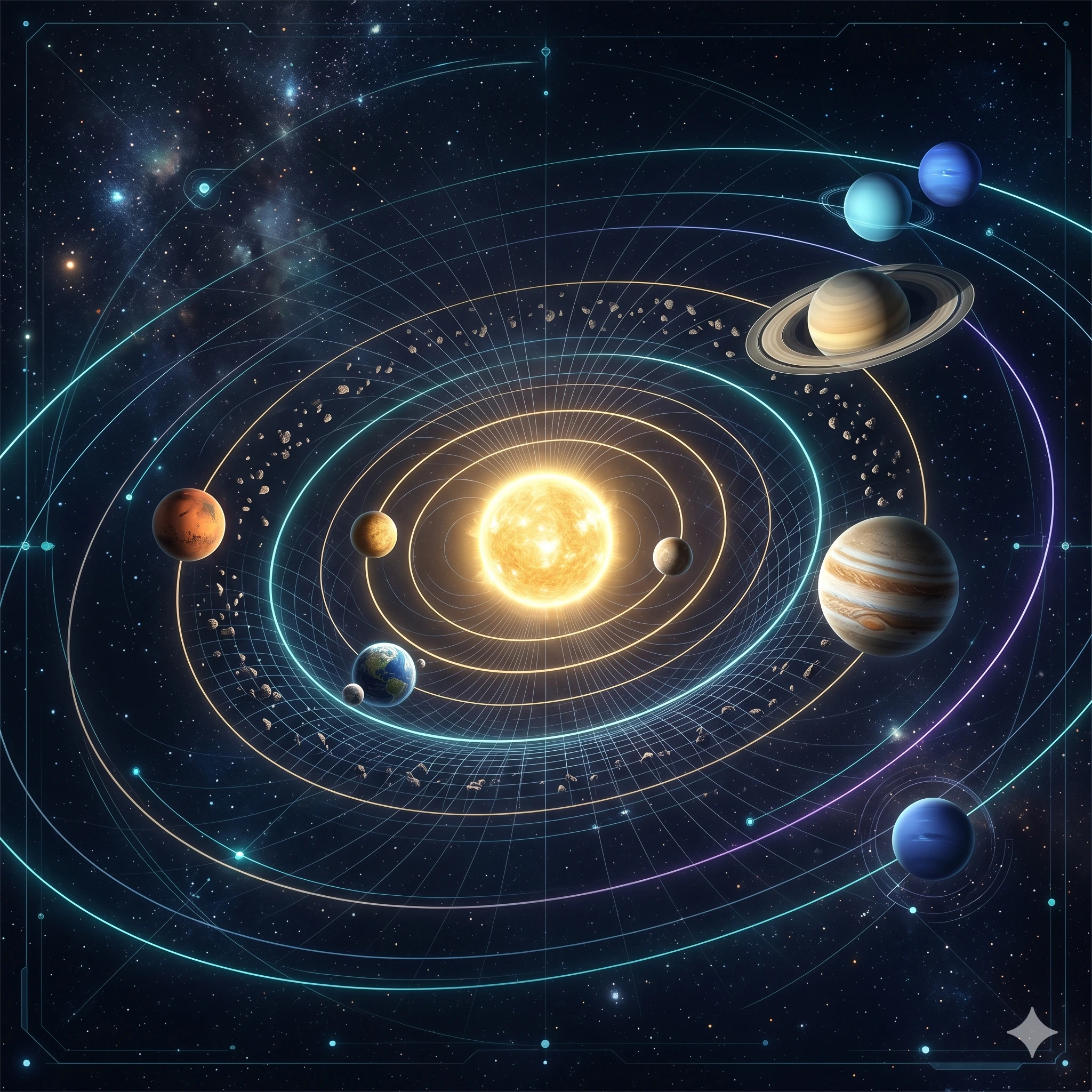
01
The cosmic clockwork
Every planet follows an orbit because it has sideways motion and is constantly pulled by the Sun’s gravity.
Without gravity, a planet would move away in a straight line. Without sideways velocity, it would fall inward.
An orbit is the balance between falling and missing.
Mercury completes one orbit in only 88 Earth days. Neptune takes about 165 Earth years. That means Neptune has
completed only one full observed orbit since it was discovered in 1846. The farther a planet is from the Sun,
the larger its orbit and the slower its orbital speed tends to be.
Use the HUD inside the simulator to adjust time speed and planet scale. The visualizer shows orbital motion,
relative speeds and the huge empty spaces between worlds.
If the Sun were a basketball, Earth would be roughly a peppercorn tens of meters away. Neptune would be far
beyond the room. The Solar System is mostly empty space.
7 amazing gravity facts about planets
A planet is not just a ball in space. It is a physical environment shaped by gravity, temperature, rotation,
composition, atmosphere and orbital history. Some planets are rocky and compact. Some are gas giants. Some spin
quickly. Some rotate strangely. Some have storms larger than Earth.
Mercury is shrinking
Mercury’s interior has cooled over time, causing the planet to contract and wrinkle its surface.
Venus is a greenhouse warning
Venus is hotter than Mercury because its dense carbon dioxide atmosphere traps heat efficiently.
Mars makes you lighter
Mars has only about 38% of Earth’s surface gravity, so jumping and lifting would feel very different.
Jupiter bends small worlds
Jupiter’s enormous gravity strongly influences asteroids, comets and the structure of the outer Solar System.
Saturn is less dense than water
Saturn’s average density is lower than water, even though no real bathtub could hold it.
Uranus rolls sideways
Uranus has an extreme axial tilt, making its seasons unlike those of any familiar world.
Neptune has brutal winds
Neptune’s atmosphere can produce some of the fastest winds measured in the Solar System.
Mercury
Inner world:
Closest planet to the Sun, fast orbit, extreme temperature swings.
Your weight on other worlds
Gravity changes how your body feels. Your mass stays the same, but your weight changes because weight is the
force of gravity acting on your mass. On Mars or Mercury, you would feel much lighter. On Jupiter, if there were
a solid surface to stand on, you would feel more than twice as heavy.
The planetary comparator below lets you enter your weight and see how different worlds would change your physical
experience. It also shows temperature and survival notes, reminding us that gravity is only one part of habitability.
Enter your Earth weight and select a planet to compare gravity, temperature and survival conditions.
| Planet | Gravity vs Earth | 70 kg Earth weight feels like | Jump effect |
|---|---|---|---|
| Mercury | 0.38g | 26.6 kg | About 2.6× higher |
| Venus | 0.91g | 63.7 kg | Similar to Earth |
| Earth | 1.00g | 70.0 kg | Baseline |
| Mars | 0.38g | 26.6 kg | About 2.6× higher |
| Jupiter | 2.53g | 177.1 kg | Much lower |
| Saturn | 1.07g | 74.9 kg | Close to Earth |
| Uranus | 0.89g | 62.3 kg | Slightly higher |
| Neptune | 1.14g | 79.8 kg | Slightly lower |
Artemis II and lunar gravity
Gravity is not only something planets have. It is also something mission designers use. Artemis II sent astronauts
around the Moon on a free-return style trajectory, using the Earth-Moon system’s gravity to shape the path home.
NASA’s trajectory visualizations show Orion looping around the Moon and returning to Earth, with the actual path
depending on mission timing and flight data.
This is the same deep idea behind orbital mechanics: a spacecraft does not simply “drive” through space. It falls
through curved paths shaped by gravity and velocity. Small engine burns can place it onto a route where gravity does
much of the work.
Launch the simulation to follow Orion through Earth orbit, outbound coast, lunar flyby, return flight and re-entry.
A free-return trajectory is a path where the Moon’s gravity helps bend the spacecraft back toward Earth.
It is not magic — it is orbital mechanics designed with precision.
Solar system quiz
Test the core idea: planets are not just places. They are physics environments. Gravity, temperature, orbital
distance and atmosphere change what each world is like.
Question 1 of 6
Knowledge check
System ladder
From the Sun outward
A simplified tour of solar-system neighborhoods.
-
Sun
EngineFusion light and the gravity well that dominates.
-
Inner
Rocky planetsMercury through Mars — denser worlds.
-
Belt
AsteroidsLeftover rocky bodies between Mars and Jupiter.
-
Outer
GiantsGas and ice giants with many moons.
-
Edge
Small bodiesKuiper-belt / Oort-cloud populations farther out.
FAQ: Solar System Explorer
What is Solar System Explorer?
Solar System Explorer is an interactive Mindivr page about planets, gravity, orbital motion and lunar mission physics.
Why do planets orbit the Sun?
Planets orbit because they have sideways velocity while the Sun’s gravity pulls them inward. An orbit is continuous falling around the Sun.
Does your mass change on other planets?
No. Your mass stays the same. Your weight changes because each planet has different surface gravity.
Why include Artemis II?
Artemis II shows that gravity is not only a planetary force. Mission designers use gravity to shape spacecraft trajectories.
-
NASA Solar System Exploration —
Solar System overview
. -
NASA Solar System Exploration —
Planets
. -
NASA Scientific Visualization Studio —
Artemis II mission trajectory
. -
NASA Scientific Visualization Studio —
Nominal Artemis II mission trajectory
. -
NASA —
Artemis mission updates
.
Editorial note: This interactive article uses Mindivr simulators, official NASA educational resources and human editorial review.
The Edge of the Observable Universe
Why the universe has an observable horizon, but not necessarily a wall.
Can AI Discover New Laws of Physics?
How machine learning may reveal hidden physical patterns.
How Newton & Einstein Saw What Others Missed
Two minds, gravity, time and the hidden structure of reality.
Get one science mystery and one puzzle every week.
Join Mindivr for interactive science articles, visual explanations and curiosity-first science stories.
Join the conversation
Share a thoughtful question, correction, or insight. Keep it civil and evidence-aware.