
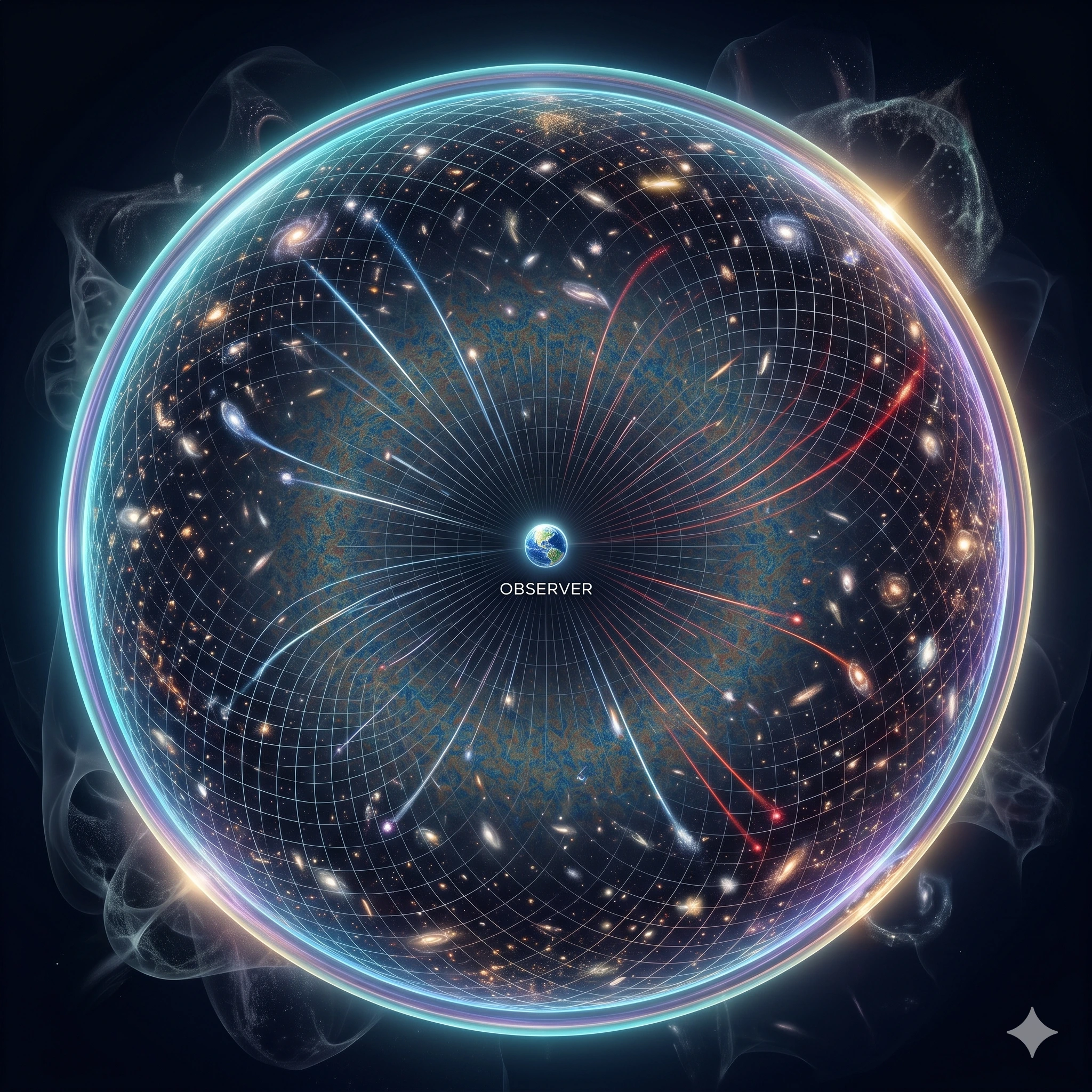
The edge of the observable universe is not a wall, a border or the place where reality stops.
It is the limit of what light has had time to show us since the beginning of the universe.
Few ideas in cosmology feel more mysterious than the edge of the observable universe. The phrase sounds like a cliff
at the end of existence — a final glowing boundary where galaxies stop and nothing begins. But that image is misleading.
The observable universe has an edge because observation has limits, not because space necessarily has one.
Light travels fast, but not infinitely fast. The universe has a finite age. That means there are places so distant that
their light has not had enough time to reach Earth. They may exist. They may contain galaxies, stars, planets and cosmic
structures. But from our location in the universe, they remain beyond the horizon of information.
This is why the word “observable” matters. The observable universe is not the entire universe. It is the part of the
universe from which light, or any other signal, has had time to reach us. Another galaxy far away would have its own
observable universe centered on itself. Its cosmic horizon would not be exactly the same as ours.
The edge is not where reality ends. It is where information stops reaching us.
To understand the edge of the observable universe, we need to separate three ideas: the age of the universe, the speed
of light and the expansion of space. The surprising result is that the farthest things we can observe today are not
merely 13.8 billion light-years away. Because space has expanded while their light traveled, the current distance to
the edge of the observable universe is much larger.
Why the observable universe has a limit
The observable universe has a limit for one simple reason: the universe has not existed forever. If the universe were
infinitely old and light could travel forever through unchanged space, we might imagine seeing endlessly far. But the
universe has a history. It began in a hot, dense early state and has been expanding and cooling ever since.
The best measurements place the universe’s age at about 13.8 billion years. That does not mean we see only objects
13.8 billion light-years away. It means the oldest light has been traveling for roughly that amount of time. While that
light traveled, the space between us and the source expanded.
This expansion changes the meaning of distance. A galaxy whose light has traveled for billions of years may now be much
farther away than the travel time of its light suggests. Cosmology uses different distance concepts because “how far away”
is not a single simple question in an expanding universe.
The limit exists because light needs time. We are not seeing the universe “as it is now” at every distance. We are seeing
nearby galaxies as they were relatively recently, distant galaxies as they were billions of years ago, and the earliest
visible glow as it was when the universe first became transparent.
Looking far away in space is also looking backward in time. The observable universe is a time machine with a horizon.
Is there a real edge to space?
The short answer is: we do not know that space has a true edge. The observable universe has an edge, but the whole
universe may be much larger than what we can see. It may even be infinite. The edge we talk about in cosmology is usually
an observational edge, not a physical boundary.
A useful analogy is the ocean horizon. If you stand on a ship, you see a circular horizon around you. The horizon is real
as a limit of vision, but it is not the edge of the ocean. Another person far away sees a different horizon centered on
them. The observable universe works similarly, except the limit is caused by the speed of light, the age of the universe
and the expansion of space.
This does not mean the edge is unimportant. Horizons can be physically meaningful. The observable boundary tells us what
information can reach us. It defines the region of the universe we can directly study. It shapes what cosmology can test
and what may remain forever beyond direct observation.
A horizon is not always the end of something. Sometimes it is the limit of what your position allows you to know.
The edge of the observable universe is therefore not like the edge of a table. You cannot fly to it and touch a border.
If you traveled toward it, your own observable universe would shift with you. You would see new regions ahead and lose
some regions behind. The horizon belongs to the observer.
What lies beyond the observable universe?
Beyond the observable universe, there may simply be more universe. More galaxies. More dark matter. More cosmic web.
More regions that follow the same physical laws. The simplest assumption is that the universe continues beyond what
we can see, at least for some distance.
But because light from those regions has not reached us, we cannot directly observe them. We can infer possibilities
from the large-scale structure we do see, from cosmic microwave background patterns and from the geometry of space,
but we cannot take a telescope image of what lies beyond our horizon.
This is where cosmology becomes both scientific and humbling. Science can make models of the unobservable, but it must
stay honest about what is measured and what is inferred. The universe beyond the observable horizon is not fantasy.
It is a real possibility constrained by physics, but not directly visible from Earth.
| Idea | What it means | Can we observe it directly? |
|---|---|---|
| Observable universe | The region from which light or signals have reached us. | Yes, in principle. |
| Whole universe | Everything that exists, including regions beyond our horizon. | Not fully. |
| Cosmic horizon | The information boundary created by light travel time and expansion. | We observe up to it, not beyond it. |
| True edge of space | A physical boundary where space ends. | No evidence that this is what our horizon is. |
The most important distinction is this: “beyond what we can observe” does not mean “beyond reality.” It means beyond
the part of reality connected to us by light so far.
Why the universe is larger than 13.8 billion light-years
This is one of the most common cosmology confusions. If the universe is about 13.8 billion years old, why is the observable
universe often described as having a radius of about 46.5 billion light-years?
The answer is expansion. Imagine light leaving a distant region in the early universe and traveling toward us. During
the entire journey, space itself is expanding. The light still travels at the speed of light locally, but the distance
between large-scale regions can increase while the light is in transit.
By the time that ancient light reaches us, the region that emitted it is no longer at the distance it was when the light
began its journey. In present-day comoving distance, it can be much farther away. That is why the observable universe’s
current radius is far larger than 13.8 billion light-years.
Earth
Step 1:
Our observation point inside the universe. Every observer has their own cosmic horizon.
So the universe is not “breaking” the speed of light in the everyday sense. Locally, light still obeys its speed limit.
The confusion comes from applying a static-space intuition to an expanding universe. On cosmic scales, the stage itself
changes while the light crosses it.
The cosmic microwave background: the oldest light we can see
The cosmic microwave background, or CMB, is often described as the oldest light in the universe. It is leftover radiation
from the early hot universe, stretched by cosmic expansion into microwave wavelengths. It fills the sky in every direction.
Before the CMB was released, the universe was hot, dense and filled with charged particles and photons. Light could not
travel freely for long distances because it kept scattering off free electrons. The early universe was like a glowing fog.
When the universe cooled enough for atoms to form, light could finally travel freely. That ancient light is what we now
detect as the cosmic microwave background.
The CMB is not the edge of space. It is the oldest electromagnetic light we can directly observe. Beyond it, the universe
existed, but it was opaque to light. To study earlier moments, scientists use indirect evidence and other messengers,
not ordinary visible light.
The CMB is not the universe’s first page. It is the first page that light lets us read.
This is why the edge of the observable universe is layered. There is the farthest light we can see, the particle horizon
that defines what could have influenced us, and the deeper question of what exists beyond our ability to observe directly.
The universe is not only big. It is observationally layered.
What the cosmic edge teaches us about reality
The edge of the observable universe teaches a strange lesson: reality is larger than information. What exists and what
we can know are not always the same thing. The universe may continue beyond our horizon, but that continuation is not
directly available to our telescopes.
This does not make cosmology weak. It makes it disciplined. Cosmology is the science of drawing careful conclusions from
incomplete light. It turns redshifts, background radiation, galaxy surveys and mathematical models into a map of what can
be known.
The observable universe is therefore both enormous and limited. Enormous because it contains hundreds of billions of
galaxies and stretches across tens of billions of light-years. Limited because it is still only the region from which
information has reached us.
The edge of the observable universe explained in one sentence: it is the boundary of what the universe has had time to
reveal to us, not necessarily the boundary of what exists.
The edge of the observable universe is not the end of reality. It is the end of the message that has reached us.
Somewhere beyond that horizon, there may be more galaxies, more darkness, more structure and more questions. We cannot
see them directly from here. But the existence of a horizon does not make the universe smaller. It makes our position
inside it more meaningful.
Knowledge check
Distance ladder
From neighborhood to cosmic horizon
Climb outward until light-travel time — not a brick wall — sets the limit.
-
Solar
Local systemPlanets and the Sun on human travel scales.
-
Milky Way
GalaxyHundreds of billions of stars in one gravitational city.
-
Local volume
Nearby galaxiesGroups and clusters still mapped in detail.
-
Deep field
Ancient lightTelescopes catch galaxies as they were long ago.
-
Horizon
Observable limitBeyond this, light has not reached us yet.
FAQ: The edge of the observable universe
What is the edge of the observable universe?
It is the farthest boundary from which light or other signals have had time to reach us since the universe began.
It is an observational horizon, not necessarily the edge of all space.
Is the observable universe the whole universe?
Probably not. The observable universe is only the part connected to us by light so far. The whole universe may be
much larger, and it may even be infinite.
Why is the observable universe bigger than 13.8 billion light-years?
Because space expanded while ancient light traveled toward us. The light travel time is about the age of the universe,
but the present-day distance to the farthest observable regions is much larger.
Can we see beyond the cosmic microwave background?
Not with ordinary electromagnetic light. Before the CMB was released, the universe was opaque. Earlier conditions
are studied indirectly through theory and other possible cosmic messengers.
-
NASA Scientific Visualization Studio —
Oldest Light in the Universe
. -
ESA —
Planck and the cosmic microwave background
. -
NASA WMAP —
WMAP Overview
. -
NASA WMAP —
Age of the Universe
. -
NASA WMAP —
Shape of the Universe
. -
Ned Wright’s Cosmology Tutorial, UCLA —
Cosmology Tutorial
.
Editorial note: This article was created through Mindivr’s editorial process: topic research, source review,
visual explanation design and human editing. If you spot an error, please use the contact page.
What Is Dark Matter?
The invisible mass shaping galaxies and the cosmic web.
Black Holes Explained Without Sci-Fi
A clear visual guide to gravity, horizons and warped spacetime.
Can AI Discover New Laws of Physics?
How machine learning may help reveal hidden physical patterns.
Get one science mystery and one puzzle every week.
Join Mindivr for interactive science articles, visual explanations and curiosity-first science stories.
If this article made you curious, support the next one.
Mindivr is built for premium visual science explanations. Your support helps create more interactive articles,
diagrams and science puzzles.
Join the conversation
Share a thoughtful question, correction, or insight. Keep it civil and evidence-aware.