
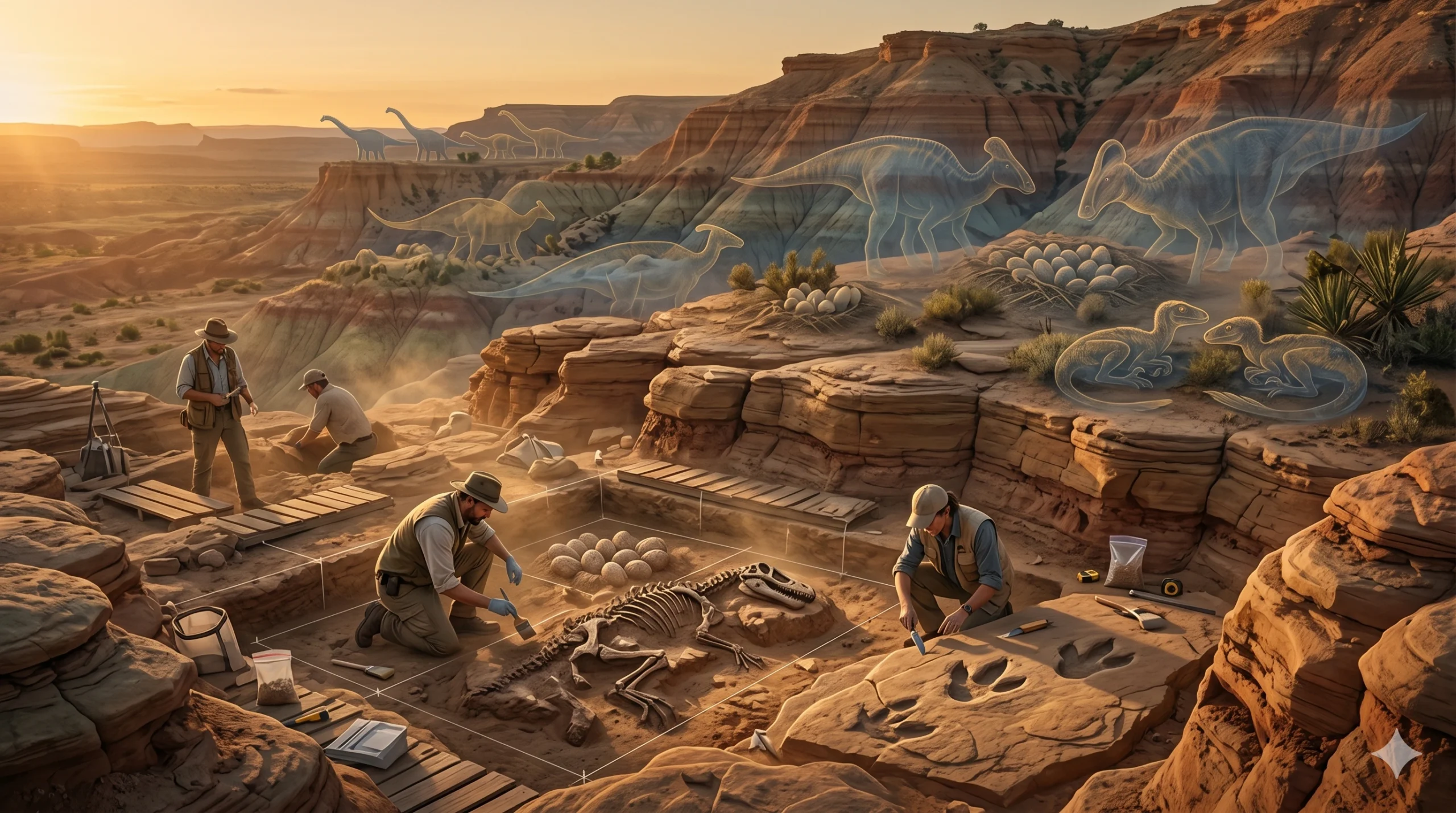
Best dinosaur fossil sites are not storage rooms for skeletons. They are ancient landscapes preserved in stone — places where dinosaurs walked, nested, rested, died and became part of Earth’s geological memory.
Fossil sites do not only show where dinosaurs died. The best ones help reconstruct where they lived, moved, nested, gathered and sometimes rested inside ancient ecosystems. Sleep is soft; fossils are hard — so most sleep evidence is indirect.
Can fossils show where dinosaurs slept?
The question “Where do dinosaurs sleep?” sounds almost childish. We imagine a Tyrannosaurus curled like a giant bird, or a small feathered dinosaur tucked into a sheltered hollow. But sleep is a temporary behavior. Fossils usually preserve hard parts, burial context and rare traces of activity — not a bedtime diary.
A footprint records movement. A nest records reproduction. Eggs record breeding sites. A trackway may be consistent with direction, relative speed or group movement. A resting trace can sometimes preserve posture. Sleep is harder: paleontologists would need a rare combination of body posture, sediment context, preservation style and comparison with living animals.
Some fossils of small dinosaurs and early birds show curled sleep-like or resting postures. Those specimens are rare and support cautious behavioral interpretation — not a map of where every dinosaur routinely slept. The bigger picture comes from fossil sites: nests, juveniles, eggs, repeated footprints and many individuals of the same species can reveal habitats dinosaurs used repeatedly.
Fossils rarely preserve sleep itself. They more often preserve the stage around sleep: nests, shelters, trackways, bonebeds, mudflats and ancient landscapes. A fossil site may not show one dinosaur asleep, but it can show where dinosaurs lived and nested.
Best dinosaur fossil sites on Earth
The best dinosaur fossil sites are famous for different reasons. Some are rich in skeletons. Some preserve feathers or other delicate details. Some show footprints. Some reveal eggs and nesting. Some capture a critical interval in Earth history.
A locality becomes exceptional when organisms lived there, burial conditions favored preservation, and later geology exposed fossils without destroying the context. Death is common; fossilization is rare; great fossil sites are rarer.
Important clarification: many famous names are not single dig pits. Hell Creek and Morrison are formations spanning many exposures. Liaoning and Patagonia host multiple localities. Dinosaur Provincial Park is a protected park with rich exposures. Treat each entry as a region, formation, biota or park — not one hole in the ground.
Some places can be visited, some are protected research areas, and collecting fossils without permission is often illegal and destructive. The goal here is scientific context, not a collecting guide.
Seven fossil regions time forgot
1. Dinosaur Provincial Park — Alberta, Canada
Dinosaur Provincial Park is a UNESCO World Heritage Site in Alberta’s badlands. Its Late Cretaceous (Campanian) river, floodplain and coastal-plain rocks preserve an exceptionally diverse dinosaur and vertebrate assemblage — a preserved landscape, not only isolated bones.
The park helps scientists study how many dinosaur species lived together, how river systems buried remains, and how Late Cretaceous ecosystems worked. Access to sensitive fossil areas is controlled; research collecting requires permission.
2. Hell Creek Formation — Montana, North Dakota, South Dakota and Wyoming, USA
Hell Creek is a Late Cretaceous geological formation (with some Paleocene rocks near the top) famous for the final chapter of non-avian dinosaurs: Tyrannosaurus rex, Triceratops, hadrosaurs and the broader latest Cretaceous ecosystem approaching the K–Pg extinction around 66 million years ago.
It is not one quarry. It is a rock unit with many exposures across several states. The Hell Creek Fossil Area in Montana is recognized as a U.S. National Natural Landmark, underscoring its importance as a window on the end-Cretaceous world.
3. Morrison Formation — western United States
The Morrison Formation is a Late Jurassic rock unit across much of the western United States. It is classic “Jurassic giants” territory: sauropods, Stegosaurus, Allosaurus and other icons known from river-channel and related deposits.
Morrison matters because it opens a different deep-time window from Hell Creek — Late Jurassic ecosystems rather than the final Cretaceous. Dinosaur National Monument’s famous bone quarry is one of many Morrison exposures, not the entire formation.
4. Liaoning fossil beds / Jehol Biota — northeastern China
Western Liaoning and neighboring areas preserve the Early Cretaceous Jehol Biota, a lagerstätte famous for exceptional preservation: feathered dinosaurs, early birds, mammals, insects and plants, often with soft tissues or body outlines that ordinary sites lose.
These fossils reshaped the public image of dinosaurs by documenting feathers and the dinosaur–bird continuum. Liaoning is a region of fossil-bearing formations and localities, not a single tourist dig.
5. Flaming Cliffs (Bayanzag) and the wider Gobi — Mongolia
Flaming Cliffs, also known as Bayanzag, became famous after 1920s Central Asiatic Expeditions recovered dinosaur eggs and nests, helping establish clear evidence of dinosaur reproduction in the Gobi Desert.
The wider Djadokhta Formation Gobi also yields Velociraptor, Protoceratops and other classic animals. The celebrated “Fighting Dinosaurs” specimen — Velociraptor and Protoceratops locked together — was found at Tugriken Shireh (also spelled Tugrik Shire / Tögrögiin Shiree), a related Gobi locality, not at Flaming Cliffs itself. Flaming Cliffs remains historically important for nests and eggs; the fight specimen belongs to another nearby Djadokhta site.
6. Isle of Skye — Scotland
The Isle of Skye is important mainly for Middle Jurassic dinosaur footprints and tracksites rather than giant mounted skeletons. Trackways capture moments of movement on ancient coastal or lagoonal surfaces.
Tracks can support cautious interpretations about locomotion and environment. They do not, by themselves, prove sleep — or prove herd behavior in every case. Skye reminds us that a dinosaur fossil can be a step, not only a bone.
7. Patagonia fossil sites — Argentina
Patagonia is associated with some of the largest known dinosaurs, including giant titanosaurs from multiple Argentine formations and localities. The region expands the story beyond familiar North American sites and raises questions about extreme body size, growth and southern ecosystems.
“Patagonia” is a broad geographic label. Scientific claims should point to specific formations and discoveries when precision matters; here it stands for a cluster of major southern fossil regions famous for sauropod gigantism.
| Name | What kind of place | Main window | Why it matters |
|---|---|---|---|
| Dinosaur Provincial Park | UNESCO park / badlands exposures | Late Cretaceous | Exceptional diversity and ecosystem context |
| Hell Creek Formation | Geological formation (many exposures) | Latest Cretaceous → K–Pg | End-Cretaceous dinosaurs and extinction context |
| Morrison Formation | Geological formation (many exposures) | Late Jurassic | Classic sauropod-rich Jurassic landscapes |
| Liaoning / Jehol | Biota / fossil beds | Early Cretaceous | Feathers, soft-tissue detail, bird origins |
| Flaming Cliffs / Gobi | Locality within wider Djadokhta region | Late Cretaceous | Eggs, nests; nearby sites preserve dramatic behavior fossils |
| Isle of Skye | Tracksites / coastal exposures | Middle Jurassic | Footprints and movement traces |
| Patagonia | Regional cluster of sites/formations | Mainly Cretaceous giants | Extreme sauropod size and southern ecosystems |
Why some places preserve dinosaurs better than others
Dinosaurs did not become fossils just because they died. Most carcasses are eaten, scattered, weathered or destroyed. Fossilization usually needs rapid burial, suitable sediment, mineral-rich waters and long-term geological stability.
Rivers and floodplains can bury bones quickly. Lakes and volcanic ash can seal delicate bodies. Deserts can bury animals in sand. Later uplift and erosion must expose the right layers without grinding everything away. That is why fossil maps are biased: they show where preservation and exposure happened, not a complete map of everywhere dinosaurs lived.
- Death and burial — remains enter sediment before complete destruction.
- Mineralization — minerals replace or infill bone and other hard parts.
- Deep time — rocks survive burial, heat and deformation long enough.
- Exposure and discovery — erosion or excavation reveals fossils for study.
Fossil site vs museum: what is the difference?
A fossil site is where fossils occur in geological context. A museum is where specimens are conserved, studied and displayed. Museums are essential, but they are not sleeping places of dinosaurs. The animals lived in ancient environments; museums hold the evidence.
When you see a mounted skeleton, you are looking at reconstruction and curation. When you study a formation or park, you are looking at the landscape that made that reconstruction possible.
What fossil sites teach us about deep time
Best dinosaur fossil sites teach humility. They show that Earth changes, continents move, climates shift and ecosystems rise and fall. They also show the limits of evidence: footprints are not diaries, bonebeds are not family albums, and a curled posture is not proof of a nightly routine.
Used carefully, these places turn dinosaurs into animals that nested, walked, fought, grew and died inside real environments — and, occasionally, left traces consistent with rest.
Knowledge check
Site ladder
From souvenir to scientific gold
How fossil localities gain research power.
-
Find
DiscoveryA fossil appears — exciting, still incomplete.
-
Map
LocalityGPS, photos, and formation notes lock context.
-
Layer
StratigraphyWhich rock layer = which time window.
-
Prep
Lab workPreparation and curation preserve information.
-
Publish
Shared dataDescriptions and repositories let others test claims.
FAQ: Best dinosaur fossil sites
What are the best dinosaur fossil sites?
Scientifically important examples include Dinosaur Provincial Park (Canada), Hell Creek and Morrison formations (USA), Liaoning/Jehol beds (China), Flaming Cliffs and related Gobi localities (Mongolia), Isle of Skye tracksites (Scotland), and major Patagonian fossil regions (Argentina).
Can fossils show where dinosaurs slept?
Sometimes fossils can suggest resting or sleep-like postures, but sleep is difficult to demonstrate directly. Nests, eggs, resting traces, footprints and repeated habitat use provide indirect clues.
Why are fossil sites important?
They preserve context: environment, nearby species, sediment layers, trackways and patterns that a single isolated bone cannot explain.
Can visitors collect dinosaur fossils?
In protected parks and scientific sites, collecting without permission is usually illegal and can destroy evidence. Follow local laws and use official tours or museum programs.
Sources and references
- UNESCO World Heritage Centre — Dinosaur Provincial Park
- U.S. National Park Service — Hell Creek Fossil Area National Natural Landmark
- U.S. National Park Service — Morrison Formation (Dinosaur National Monument)
- American Museum of Natural History — Fossils from Liaoning
- Zhou et al. — The Jehol Biota, an Early Cretaceous terrestrial Lagerstätte (National Science Review)
- Dashzeveg et al. (2005) — Djadokhta Formation subdivision; Fighting Dinosaurs at Tugrugyin Shireh
- Fastovsky et al. — Paleoenvironments of Tugrikin-Shireh (Gobi Desert)
- Mindivr — The Age of Dinosaurs (DEV)
- Mindivr — Frozen Dinosaurs in Antarctica (DEV)
- Mindivr — T. rex vascular structures (DEV)


Join the conversation
Share a thoughtful question, correction, or insight. Keep it civil and evidence-aware.