

Maybe it’s not a happy memory. Maybe it’s just a feeling — stone steps in the morning sun,
mountains in the distance, a rooster somewhere far away. And in that moment, something in you
becomes lighter. Your brain knows exactly what that means, even when you can’t explain it.
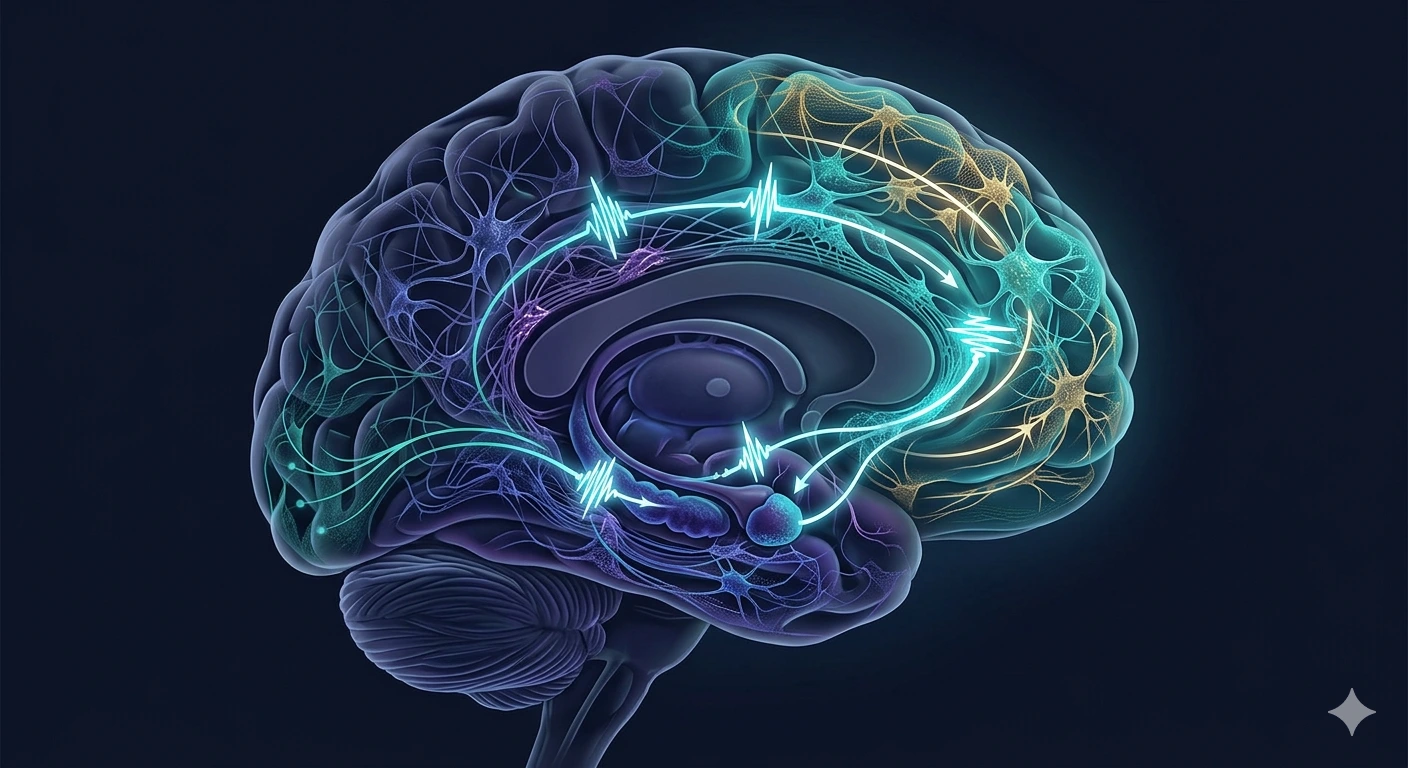
can reshape the way the brain prepares for reality.
Rowling knew it too. And she put it right at the heart of the most beautiful scene in the
entire series. By looking closer at the Expecto Patronum neuroscience, we
can unlock how Harry actually cast the spell. This principle is similar to how
the brain stores memory as an evolving network
rather than a fixed container.
The Expecto Patronum Neuroscience Scene That Changes Everything
Prisoner of Azkaban. The lake. Dementors closing in. Harry waits for someone — a figure
across the water — to cast a Patronus and save him. He’s certain he sees it. He’s certain
someone is coming.
He does not gain new information in the usual way. He sees a version of success before
he becomes the one who creates it. The important shift is not power. It is certainty.
He didn’t learn something new. He didn’t gain new powers. He simply
stopped doubting — because he already had proof. Proof that came from
his own future self. This is a core pillar of Expecto Patronum neuroscience.
The Memory That Isn’t a Memory: 7 Secrets of Recall
Here’s the thing about Lupin’s instruction — “think of the happiest thing you can
remember” — most people misunderstand it. Harry didn’t think of a happy event.
He thought of a feeling. In Expecto Patronum neuroscience, we can
understand this through the power of emotionally loaded recall.
Neuroscientists have a name for what you experience when a sound, a smell, or a texture
suddenly pulls you back to a moment you weren’t even trying to remember. These memories
can arrive quickly, emotionally and almost physically, before you have time to explain them.
The rooster at dawn. The warmth of stone steps. The silence of mountains. Your brain
stored all of that in a part of memory that doesn’t respond only to logic — it also
responds to sensation, emotion and context. This is one of the
7 amazing secrets behind internal certainty.
The Pygmalion Effect: Neuroscience Proves Rowling Right
In 1968, Harvard psychologist Robert Rosenthal conducted a landmark study. He told teachers
certain students were “intellectual bloomers.” Those students outperformed others simply
because they were expected to. This phenomenon, known as the Pygmalion Effect, is a
cornerstone of Expecto Patronum neuroscience.
Harry didn’t become more powerful at the lake. What changed was his certainty — and
certainty is a neurological state that can change what the brain is ready to do.
Expectation is not the same as guaranteed success. But expectation can shift attention,
confidence, body state and behavior. When someone expects you to succeed — or when you
deeply expect yourself to succeed — the brain may enter a different mode of preparation.
| Belief state | Possible brain/body effect |
|---|---|
| Doubt | More monitoring, hesitation and threat scanning. |
| Hope | More attention toward possibility and next action. |
| Certainty by preview | The brain simulates success before the result is confirmed. |
| Emotional memory | A stored feeling becomes a stabilizing anchor in the present. |
Certainty Simulation: What Your Brain Already Knows
Harry didn’t need new information. He needed to stop second-guessing. The moment he saw
himself succeed, the doubt dissolved. This is the ultimate lesson of
Expecto Patronum neuroscience.
When we imagine a future self succeeding, the brain can treat that image as a kind of
internal rehearsal. It does not prove the future. But it can change the feeling of
possibility.
This connects deeply with Mindivr’s puzzle-based thinking: the
brain often learns by simulating possible paths before testing them. In a puzzle, you
preview a move. In life, you preview a future self. In both cases, the brain is trying
to reduce uncertainty.
Expecto Patronum neuroscience?
Your Real Patronus: The Final Reveal
Rowling gave Harry something science took decades to understand: that the memory powering
your Patronus doesn’t need to be a perfect joyful event. It needs to be real.
The real power is not the memory alone. It is the way the memory changes the state of the
brain. A meaningful memory can redirect attention, calm threat signals, create a sense of
agency and make the next action feel possible.
Explore the Expecto Patronum neuroscience within you. Belief is not
magic. It is a biological preview of what your brain is preparing to do next.
The useful lesson is not “believe anything hard enough.” The lesson is more precise: build
memories, environments and expectations that help the brain act with clarity instead of
panic.
If you want to explore more brain mysteries, read
How Much Can the Brain Store?, browse the
full Mindivr interactive science articles library,
or try a daily puzzle in Mindlink.
Knowledge check
Learning ladder
From spark of belief to tested skill
How provisional confidence can help learning without skipping evidence.
-
Spark
HypothesisA provisional belief focuses attention.
-
Practice
RehearsalRepetition wires prediction and skill.
-
Feedback
Error signalsReality corrects the model.
-
Confidence
Calibrated beliefConfidence should track evidence over time.
-
Share
Test publiclyIndependent checks keep metaphors honest.
FAQ: Expecto Patronum Neuroscience
What is Expecto Patronum neuroscience?
Expecto Patronum neuroscience is a metaphorical way to explore how belief, memory,
expectation and emotion can influence the brain before conscious certainty appears.
Is belief really a biological state?
Belief can involve attention, prediction, emotion and body readiness. It is not just an
abstract thought. It can change how the brain prepares for action.
Does this mean belief can change reality?
Not directly. Belief does not rewrite physics. But it can change perception, behavior,
motivation and how the nervous system responds to uncertainty.
Why is memory important in this article?
Memory gives the brain emotional evidence. A powerful memory can make a future action
feel possible because it reminds the brain of a real state it has already experienced.
Is this article medical advice?
No. This article is educational and uses neuroscience and psychology concepts for general
understanding. It does not replace medical, psychological or professional advice.
Verified scientific research and reference material for this Expecto Patronum neuroscience guide.
- Rosenthal, R., & Jacobson, L. (1968). Pygmalion in the classroom. Holt, Rinehart & Winston.
- Mace, J. H. (2007). Involuntary autobiographical memory. Blackwell Publishing.
- Berntsen, D. (1996). Involuntary autobiographical memories. Applied Cognitive Psychology.
- Loftus, E. F. (2005). Planting misinformation in the human mind. Learning & Memory.
- PubMed
- NIH
Last reviewed: April 2026. Spotted an issue?
Contact Mindivr.
How Much Can the Brain Store?
Explore why the brain is not a hard drive and why forgetting may be useful.
Interactive Science Articles
Browse visual guides about the brain, space, nature, physics and dinosaurs.
Try Mindlink
Challenge your brain with daily science-inspired puzzles and curiosity games.
Get one science mystery and one puzzle every week.
Subscribe for visual science stories, curiosity-driven articles and future Mindlink puzzles.
If this article made you curious, support the next one.
Mindivr is built to make science visual, readable and interactive.
Join the conversation
Share a thoughtful question, correction, or insight. Keep it civil and evidence-aware.