
Newton and Einstein did not simply “know more” than other people. They saw reality differently.
Where most people saw falling apples, moving planets, ticking clocks and beams of light,
they saw patterns, contradictions and questions hiding in plain sight.
The romantic version of genius makes it look like a lightning strike. A person sits alone, inspiration
arrives, and the universe suddenly opens. But the real story is more interesting. Isaac Newton and
Albert Einstein were not magicians. They were disciplined pattern hunters. They paid attention to small
details that other people treated as normal, then asked whether those details belonged to a deeper rule.
Newton looked at motion on Earth and motion in the sky and asked a dangerous question for his time:
what if both obey the same principle? Einstein looked at light, time and gravity and asked another
dangerous question: what if the things we call “obvious” are only obvious because we move too slowly
to notice the truth?
Genius is not only the ability to answer hard questions. Sometimes, it is the ability to notice that
everyone has been asking the wrong question.
This article is not a biography of Newton and Einstein. It is a guided dive into how they thought:
how they simplified reality, challenged common sense, trusted mathematics, used imagination and saw
invisible structures behind everyday experience.
Newton and Einstein saw hidden patterns, not isolated facts
Most people experience the world as separate events. An apple falls. The Moon moves. A clock ticks.
A beam of light travels across a room. A train passes a platform. These things feel unrelated because
they happen at different scales. One belongs to daily life. Another belongs to astronomy. Another belongs
to timekeeping. Another belongs to optics.
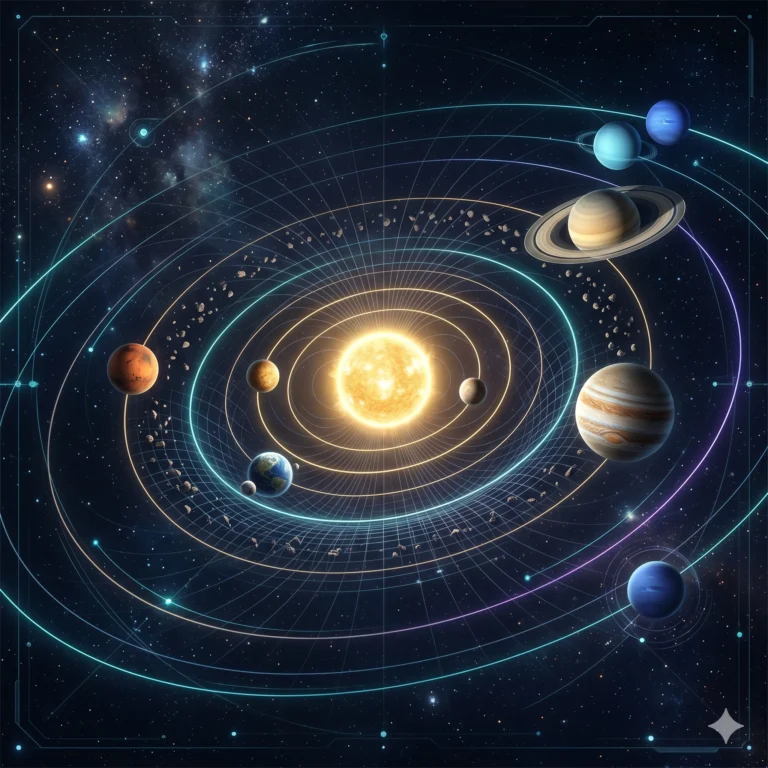
Newton’s great move was to connect motion on Earth with motion in the heavens. Instead of treating
the sky as a different kind of realm, he treated it as part of the same physical universe. The force that
pulls an object downward could also help explain why the Moon continually falls around Earth instead of
escaping into space.
Einstein’s great move was to connect things that seem even more abstract: light, motion, time, gravity
and geometry. He did not merely ask how fast objects move through space. He asked what space and time
must be like if the speed of light is always measured the same way by observers in uniform motion.
The lesson is simple but powerful: breakthroughs often begin when separate facts are no longer treated
as separate. The genius move is to ask whether different phenomena are shadows of the same deeper rule.
How Newton saw gravity where others saw falling
The famous apple story is often told as if Newton discovered gravity because fruit fell near him.
That version is too simple. People had seen falling objects for all of human history. The apple was not
the miracle. The question was the miracle.
Newton’s insight was not “things fall down.” Everyone knew that. His deeper question was: could the
same tendency that pulls an apple toward Earth also reach outward and shape the motion of the Moon?
If the Moon is always moving forward, and Earth’s gravity is always pulling it inward, then the Moon
could be understood as continuously falling around Earth.
This was a radical unification. Before modern physics, it was natural to imagine celestial motion as
separate from earthly motion. The sky looked perfect, distant and special. Earth looked messy and ordinary.
Newton helped collapse that division. The heavens and Earth were not two different physical stories.
They were one system.
Newton did not just explain falling. He made falling universal. He turned a local event into a cosmic rule.
This is one reason Newton’s work became so transformative. His laws of motion and universal gravitation
gave scientists a mathematical way to describe motion across many scales. Projectiles, planets, tides and
orbits could be understood through the same disciplined framework.
Newton saw what others missed because he refused to let scale trick him. A falling apple and an orbiting
Moon look completely different to the eye. To Newton, they could belong to the same hidden geometry of
force and motion.
How Einstein saw time where others saw clocks
Einstein’s genius had a different flavor. Newton’s world was a universe of forces acting in absolute space
and absolute time. Einstein asked what would happen if some of those “absolute” ideas were not absolute
after all.
One of Einstein’s most powerful habits was the thought experiment. Instead of needing a laboratory for
every question, he built a mental laboratory. What would you see if you could chase a beam of light?
What would happen if lightning struck two ends of a moving train? What would an observer feel inside
a sealed elevator in deep space?
These were not childish fantasies. They were precise imagination tools. Einstein used them to expose
contradictions between common sense and physical law. If the speed of light behaves in a way that does
not fit everyday intuition, then perhaps everyday intuition is the thing that must change.
Special relativity changed the meaning of time and simultaneity. General relativity changed the meaning
of gravity. Instead of treating gravity only as a force pulling objects together, Einstein described gravity
as a feature of curved spacetime. Massive objects shape spacetime, and objects move along paths inside
that geometry.
Einstein did not ask only, “How do objects move through space?” He asked, “What must space and time
be like for motion, light and gravity to behave this way?”
That shift is enormous. Newton gave science a powerful description of gravitational attraction. Einstein
changed the stage on which gravity happens. The universe was no longer just objects moving through
space and time. Space and time themselves became part of the physical story.
7 genius ways Newton and Einstein saw reality differently
Newton and Einstein were separated by centuries, tools, culture and scientific context. But their thinking
patterns share several deep similarities. These are not magic tricks. They are habits of attention.
1. They asked cleaner questions
A weak question collects facts. A strong question reorganizes them. Newton did not ask only why apples
fall. He asked whether falling and orbiting could be part of the same rule. Einstein did not ask only how
clocks work. He asked what time means for observers in motion.
2. They trusted simple ideas when the consequences were not simple
Great science often begins with a clean principle and follows it into strange territory. Newton’s laws
look compact, but they open into planetary motion. Einstein’s relativity begins from principles about
motion and light, but it leads to time dilation, length contraction and curved spacetime.
3. They used mathematics as a reality filter
Mathematics helped both thinkers protect themselves from vague intuition. Human intuition evolved for
walking, throwing, hunting and surviving at ordinary speeds and sizes. It is not naturally built for planets,
black holes or light-speed reasoning. Mathematics allowed Newton and Einstein to keep thinking when
imagination alone became unreliable.
4. They noticed contradictions
Many people ignore contradictions because contradictions are uncomfortable. Newton and Einstein moved
toward them. A contradiction can be a crack in the wall of an old idea. If the data, the theory and common
sense do not fit together, one of them may need to change.
Observation
Step 1:
Notice something ordinary that everyone else ignores.
5. They separated appearance from structure
The Moon does not look like it is falling, but Newton saw falling in orbital motion. Time does not feel
flexible, but Einstein showed that measurements of time depend on motion and gravity. Both thinkers
looked past appearance toward structure.
6. They respected imagination, but disciplined it
Imagination without discipline becomes fantasy. Discipline without imagination becomes routine. Newton
and Einstein combined both. They allowed themselves to imagine strange possibilities, then forced those
possibilities through logic, mathematics and evidence.
7. They changed the frame, not just the answer
The deepest breakthroughs do not merely answer a question. They change what kind of question can be
asked next. Newton made the universe mathematically mechanical. Einstein made space, time and gravity
dynamic. After them, reality itself had a different shape.
Newton vs Einstein: two visions of gravity
Newton and Einstein are sometimes presented as if one simply replaced the other. That is misleading.
Newtonian physics remains incredibly useful. It works extremely well for many everyday situations,
engineering problems and solar-system calculations where speeds are low compared with light and
gravitational fields are not extreme.
Einstein did not make Newton useless. He showed that Newton’s picture was an approximation inside a
deeper framework. In ordinary conditions, Newton’s equations are often accurate enough to be powerful.
In extreme conditions, such as very strong gravity or very high speeds, Einstein’s theory gives a more
complete description.
| Question | Newton’s view | Einstein’s view |
|---|---|---|
| What is gravity? | An attractive force between masses. | A curvature of spacetime caused by mass-energy. |
| What is time? | Absolute and universal. | Relative to motion and gravity. |
| What is space? | A fixed stage where motion happens. | Part of dynamic spacetime. |
| Where does it work best? | Everyday motion, engineering, many orbital calculations. | High speeds, strong gravity, cosmology, precision tests. |
This is why science is not just a collection of facts. It is a series of increasingly powerful models.
A model can be useful and still incomplete. Newton’s model was one of the most successful in history.
Einstein’s model explained why Newton’s worked so well in normal conditions and where it had limits.
What Newton and Einstein can teach us about thinking
The point of studying Newton and Einstein is not to pretend that everyone can casually become a world-changing
physicist. Their achievements required rare talent, deep technical skill and historical opportunity. But their
thinking habits are still useful.
They remind us that ordinary reality is not simple just because it is familiar. Familiar things can be the
most invisible. Falling, moving, seeing, measuring, aging, remembering and looking at the sky all feel normal.
But normal is not the same as understood.
A useful question to borrow from Newton is: “What if two things that look different are actually connected?”
A useful question to borrow from Einstein is: “What assumption am I treating as obvious only because I have
never tested it?”
Scientific genius is often described as seeing farther. But sometimes it is more accurate to say that genius
sees nearer. It looks again at the thing everyone already saw, but refuses to accept the first explanation.
It takes the ordinary and makes it strange again.
That is the real Mindivr lesson. Newton did not invent the falling apple. Einstein did not invent clocks,
trains or beams of light. They changed what those things meant. They saw not objects, but relationships.
Not events, but systems. Not common sense, but the limits of common sense.
Newton and Einstein saw what others missed because they did not stop at the surface of reality.
They asked what the surface was trying to hide.
So the next time something seems obvious, pause for a second. Obvious is often where discovery goes to
hide. The apple falls. The Moon orbits. The clock ticks. The light moves. The question is: what are you
missing because you have seen it too many times?
Knowledge check
Idea ladder
From falling apples to curved spacetime
A conceptual climb through how gravity thinking matured.
-
Fall
Everyday gravityThings fall down; that is the lived fact.
-
Newton
Universal lawOne inverse-square law links apples and planets.
-
Limits
Precision cracksMercury’s perihelion and light near mass need more.
-
Einstein
GeometryMass-energy tells spacetime how to curve; curves tell matter how to move.
-
Today
TestsLensing, clocks, and waves keep confirming the geometry picture.
FAQ: Newton and Einstein
Did Einstein prove Newton wrong?
Not in the simple sense. Einstein showed that Newtonian gravity is an approximation that works very
well in many normal conditions, while general relativity gives a deeper description for extreme gravity,
high speeds and precision cases.
Why was Newton so important?
Newton helped unify motion on Earth and in the heavens through mathematical laws. His work made it
possible to describe many physical systems with extraordinary predictive power.
Why was Einstein so important?
Einstein transformed physics by changing how scientists understand light, time, energy, gravity and
spacetime. His work reshaped modern physics and cosmology.
What did Newton and Einstein have in common?
They both saw hidden structure behind ordinary experience. They connected separate phenomena,
challenged assumptions and used mathematics to test ideas that common sense could not fully handle.
-
Stanford Encyclopedia of Philosophy —
Isaac Newton
. -
Stanford Encyclopedia of Philosophy —
Newton’s Philosophiae Naturalis Principia Mathematica
. -
Nobel Prize —
Albert Einstein Facts
. -
OpenStax Physics —
Newton’s Law of Universal Gravitation and Einstein’s Theory of General Relativity
. -
NASA Cosmic Times education material —
Newton and Einstein Gravity Fact Cards
.
Editorial note: This article was created through Mindivr’s editorial process: topic research, source review,
visual explanation design and human editing. If you spot an error, please use the contact page.
What Is Dark Matter?
Explore the invisible mass shaping galaxies and cosmic structure.
Black Holes Explained Without Sci-Fi
A clean visual guide to gravity, horizons and warped spacetime.
How Much Can the Brain Store?
Memory, synapses and why the brain is not a hard drive.
Get one science mystery and one puzzle every week.
Join Mindivr for interactive science articles, visual explanations and curiosity-first science stories.
If this article made you curious, support the next one.
Mindivr is built for premium visual science explanations. Your support helps create more interactive articles,
diagrams and science puzzles.
Join the conversation
Share a thoughtful question, correction, or insight. Keep it civil and evidence-aware.