
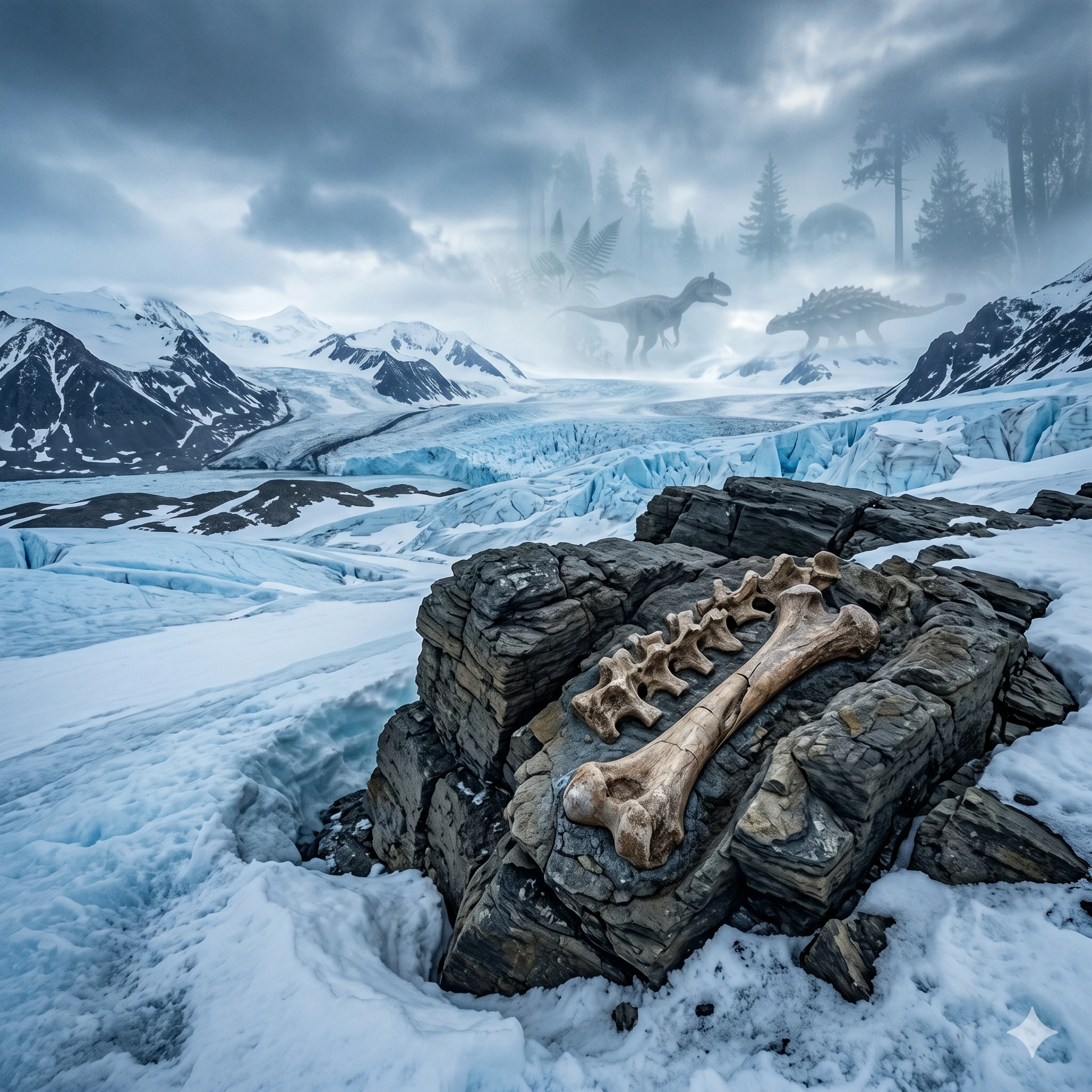
Antarctica feels like the perfect place for a prehistoric secret: endless ice, buried mountains, and a continent that still seems half-hidden. The science of frozen dinosaurs in Antarctica is not about monsters waiting to be thawed. It is about fossils in rock, ancient polar forests, moving continents, and a planet that looked nothing like the one we know today.
Scientists have not found intact frozen dinosaur bodies under Antarctic ice. Antarctica does preserve real dinosaur fossils in rock — evidence that dinosaurs lived there during warmer Mesozoic climates, not that bodies waited in a continental freezer.
Are Frozen Dinosaurs in Antarctica Real?
The short answer is no: scientists have not found intact frozen dinosaur bodies preserved under Antarctic ice. That is the most important correction to make before going deeper. The phrase is attractive because it feels plausible. Antarctica is frozen today. Ice can preserve animals. Dinosaurs lived in the distant past. Put those ideas together and the mind immediately imagines a dinosaur body sealed in a natural freezer.
But that picture does not match the geological timeline. Dinosaurs lived during the Mesozoic Era, and non-avian dinosaurs disappeared around 66 million years ago. The Antarctic ice sheet, in its modern continental form, mainly developed tens of millions of years later — major ice-sheet growth is linked to the Eocene–Oligocene transition about 34 million years ago. It did not sit unchanged across the full Mesozoic, preserving dinosaur bodies like a museum freezer.
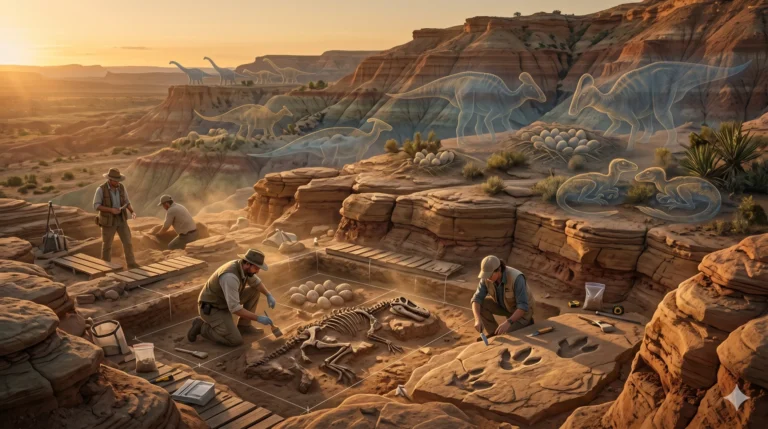
The real evidence comes from fossils in rock, not frozen bodies in ice. Those fossils can still be extraordinary. A fossil bone can reveal the presence of a dinosaur. A tooth can suggest diet. A plant fossil can show that the environment supported vegetation. A rock layer can point to rivers, floods, volcanic activity, or ancient climate conditions.
So the viral idea is wrong, but the scientific story is not boring. Antarctica really had dinosaurs. It really had ecosystems. It really had warmer periods when plants and animals could survive at high southern latitudes. The difference is that paleontology works through evidence preserved in stone, not through fantasy creatures preserved like frozen statues.
Science vs myth
Myth: Antarctica contains intact frozen dinosaur bodies under the ice.
Reality: Antarctica contains real dinosaur fossils in rock, showing that dinosaurs once lived on a much warmer polar continent.
Did Dinosaurs Actually Live in Antarctica?
Yes. This is the part that makes the story genuinely exciting. Dinosaurs did live in Antarctica, but not on the modern ice sheet. They lived during earlier geological periods when the continent was positioned differently, connected to other southern landmasses, and part of much warmer Earth systems.
During much of deep time, Antarctica was associated with Gondwana, the ancient southern supercontinent that also included landmasses related to South America, Africa, Australia, India, and Zealandia. This matters because animals and plants could spread across connected or nearby land areas in ways that are impossible on today’s map.
The Antarctica we see now is not the Antarctica dinosaurs knew. Today it is the coldest continent, dominated by ice and extreme conditions. In the Mesozoic, parts of Antarctica supported forests, rivers, floodplains, and animal communities. It still had polar light cycles, but it was not a lifeless white desert.
This changes the way we understand dinosaurs. They were not only creatures of tropical jungles or dry desert plains. They were a diverse group of animals that adapted to many environments across the planet. Some lived near ancient polar regions, where seasonal daylight and darkness created unusual ecological pressures.
Antarctic dinosaur fossils remind us that continents move and climates change. The world is not fixed. A place that is frozen today can once have been green. A place that feels empty today can once have held forests, rivers, predators, herbivores, and entire food webs.
What Ancient Antarctica Looked Like
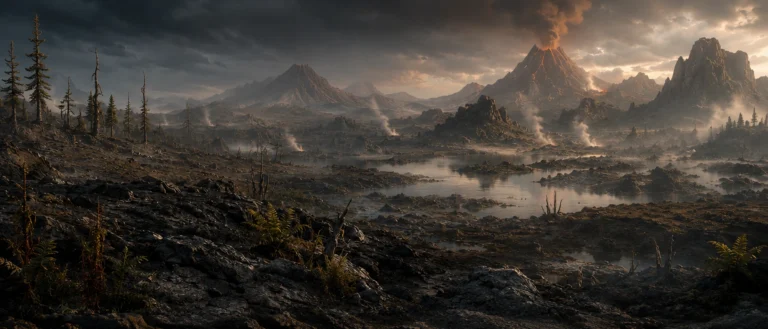
Ancient Antarctica was not one single environment. It changed across millions of years. During some periods, the continent was warmer and supported plant life. During others, conditions shifted as global climate, ocean circulation, volcanic activity, atmospheric carbon dioxide, and continental positions changed.
A good mental image is not a tropical paradise, but a high-latitude prehistoric landscape with forests, rivers, seasonal light extremes, and animals adapted to a world very different from today. There may have been long summer daylight and long winter darkness in some regions. That would have affected plants, herbivores, predators, and the entire rhythm of the ecosystem.
Plant fossils are crucial here. Leaves, wood, pollen, and other botanical remains help scientists reconstruct ancient climates. If an environment supported enough vegetation, it could support herbivorous dinosaurs. If herbivores lived there, predators could also be part of the ecosystem.
This is why Antarctic dinosaurs are not just a curiosity. They are evidence of a functioning world. A single dinosaur bone tells us that an animal lived there. But a fossil ecosystem can tell us what that animal may have eaten, what climate it experienced, and how the landscape changed.
What Fossils Have Actually Been Found?
One of the most famous Antarctic dinosaurs is Cryolophosaurus, an Early Jurassic theropod discovered in Antarctica. Its name is often interpreted as “frozen crested lizard,” a reference to both its skull crest and its Antarctic discovery context. It was a meat-eating dinosaur and is one of the most iconic animals used to show that dinosaurs lived on the southern polar continent.
Cryolophosaurus matters because it shows that theropod dinosaurs had already spread widely by the Early Jurassic. It also helps scientists think about predator evolution in southern landmasses. This was not a modern polar animal walking on ice. It was part of an ancient ecosystem preserved in rock.
Another important Antarctic dinosaur is Glacialisaurus, a sauropodomorph from the Early Jurassic. Sauropodomorphs are related to the lineage that eventually produced the giant long-necked sauropods. Glacialisaurus helps paleontologists understand early herbivore evolution and the spread of dinosaur groups across Gondwana.
Antarctopelta is another key example. It was an armored dinosaur, part of a defensive evolutionary tradition that included bony body armor. Finding armored dinosaur remains in Antarctica expands our picture of dinosaur diversity in polar regions.
These finds are not isolated trivia. They show that Antarctica was part of the dinosaur story. It was not an empty edge of the world. It was part of a connected, changing planet where animals evolved, spread, adapted, and disappeared.
| Example | What it was | Why it matters |
|---|---|---|
| Cryolophosaurus | Early Jurassic theropod from Antarctica | Shows meat-eating dinosaurs lived at high southern latitudes; name often glossed as “frozen crested lizard.” |
| Glacialisaurus | Early Jurassic sauropodomorph | Helps track early herbivore evolution and Gondwanan connections. |
| Antarctopelta | Late Cretaceous armored dinosaur | Expands the picture of Antarctic dinosaur diversity beyond Early Jurassic forms. |
Why We Do Not Find Frozen Dinosaur Bodies
Freezing and fossilization are different processes. Freezing can preserve soft tissue when an animal dies in cold conditions and remains frozen continuously. That is why some Ice Age mammals, such as mammoths, can be found with hair, skin, or soft tissue. But mammoths are recent compared with dinosaurs.
Dinosaurs are far older. Their remains usually survive through fossilization, not freezing. Bones may be buried in sediment, mineralized, compressed, broken, exposed, and eventually discovered after millions of years of geological change.
Antarctica’s ice also moves. It is not a still glass case. Glaciers grind, deform, transport, erode, and bury landscapes. The idea that a dinosaur body could simply remain perfectly frozen beneath moving ice for tens of millions of years is not consistent with what we know about geology and ice-sheet history.
Another issue is access. Much of Antarctica’s bedrock is covered by ice. Fossils are most likely to be found where rock is exposed, such as mountain ranges, nunataks, islands, or eroded formations. If a fossil-bearing rock unit is buried beneath thick ice, scientists may suspect that fossils exist there, but they cannot simply walk up and collect them.
This is why the real scientific question is not “Where are the frozen dinosaurs?” It is “Where are the exposed rocks from the right time period, and what do they preserve?” That question is harder, less sensational, and much more useful.
Could More Fossils Be Hidden Under the Ice?
Yes, more fossils may exist in Antarctica. But that does not mean there are frozen dinosaur bodies waiting to be thawed. It means that fossil-bearing rocks may be inaccessible under ice or hidden in remote regions that are difficult and expensive to study.
Antarctic fieldwork is extreme. Researchers must deal with weather, logistics, transport, safety, limited field seasons, and the difficulty of moving equipment and fossils across one of the most hostile environments on Earth. Every fossil collected from Antarctica represents a major scientific effort.
Modern tools can help. Satellite imagery, geological mapping, remote sensing, and improved expedition planning can identify promising areas. But fossils still require careful fieldwork. A scientist must reach the site, document the geological context, collect responsibly, and bring material back for preparation and study.
The hidden fossil record of Antarctica is probably incomplete. That does not make it mysterious in a supernatural sense. It makes it scientifically valuable. Each discovery adds a rare piece to the map of dinosaur evolution and ancient polar ecosystems.
Why Antarctic Dinosaur Fossils Matter
Antarctic dinosaur fossils matter because they connect paleontology with climate science, geology, evolution, and deep time. They show that Earth can transform completely. A frozen continent can once have supported forests. A remote polar landscape can once have been part of active dinosaur ecosystems.
They also help explain dinosaur distribution. When related dinosaur groups appear across southern continents, scientists can test ideas about ancient land connections, migration routes, and continental drift. Fossils are biological evidence, but they are also geographic evidence.
They matter for climate imagination too. Ancient Antarctica reminds us that climate is not static. The planet has passed through greenhouse worlds, icehouse worlds, mass extinctions, warming events, and continental rearrangements. Fossils make those changes tangible.
The phrase “frozen dinosaurs” is useful only as a doorway. Once we step through it, the real story becomes richer: Antarctica had dinosaurs, but not frozen bodies. It had forests, but not the modern world. It had ecosystems, but they are preserved in rock.
To place this article inside the bigger dinosaur story, start with The Age of Dinosaurs. Then explore T. rex Blood Vessels Found?, Where Do Dinosaurs Sleep?, and the full library of interactive science articles.
Knowledge check
Climate ladder
From greenhouse past to icy present
Why dinosaur fossils in Antarctica do not mean modern deep-freeze zoos.
-
Mesozoic
Warmer continentAntarctica was positioned and climated differently.
-
Forests
HabitatsEvidence points to vegetated, livable environments then.
-
Burial
FossilizationBones and traces enter the rock record.
-
Drift
Plate motionContinents move; Antarctica becomes isolated and colder.
-
Today
Ice sheetModern ice preserves a different research problem — not frozen dinosaurs in freezers.
Frozen Dinosaurs in Antarctica FAQ
Have scientists found frozen dinosaurs in Antarctica?
No confirmed frozen dinosaur bodies have been found in Antarctica. Scientists have found dinosaur fossils in Antarctic rocks, but not intact frozen bodies preserved in ice.
Did dinosaurs live in Antarctica?
Yes. Dinosaur fossils show that dinosaurs lived in Antarctica during warmer prehistoric periods, before the continent became the frozen landscape we know today.
What dinosaurs were found in Antarctica?
Important Antarctic dinosaurs include Cryolophosaurus, Glacialisaurus, and Antarctopelta. These fossils help scientists reconstruct ancient polar ecosystems.
Why are there no frozen dinosaur bodies?
Dinosaurs are too old for modern Antarctic ice to have preserved their bodies. Their remains survive mainly as fossils in rock, not as frozen biological tissue.
Could more dinosaur fossils still be under the ice?
Yes, fossil-bearing rocks may exist beneath Antarctic ice, but they are difficult to access. Any discoveries would most likely be fossils, not frozen dinosaur bodies.
Why is Antarctica important for dinosaur science?
Antarctica helps scientists understand dinosaur distribution, ancient climates, continental drift, and how life adapted to high-latitude environments.
Sources and references
- Natural History Museum — Cryolophosaurus dinosaur directory
- Natural History Museum of Los Angeles County — Antarctic Dinosaurs
- British Antarctic Survey — Fossils from the Antarctic
- Field Museum — Polar Studies research
- UC Museum of Paleontology — Mesozoic Era overview
- British Antarctic Survey — Eocene–Oligocene Antarctic climate transition
- Science — Antarctic Ice Sheet variability across the Eocene–Oligocene transition
Editorial note: This DEV migration preserves the production article’s fossil-first Antarctic dinosaur narrative, converts legacy interactive widgets into static Article Core components, and clarifies Antarctic ice-sheet timing using institutional climate-transition references. Continue with The Age of Dinosaurs on DEV.
Join the conversation
Share a thoughtful question, correction, or insight. Keep it civil and evidence-aware.