
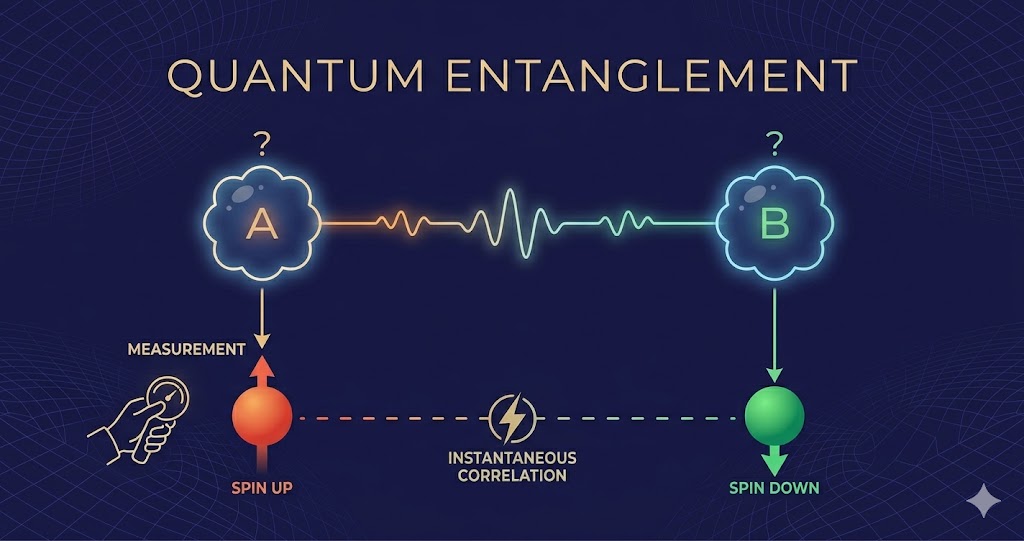
Quantum entanglement explained simply: it is not magic communication between particles.
It is a shared quantum state where separate particles must be described together, even when distance
makes them look independent.
Few ideas in physics sound more mysterious than quantum entanglement. It is often described as two particles
“knowing” what happens to each other instantly, even across huge distances. That description is dramatic,
but it can also be misleading. Entanglement is not telepathy. It is not a secret signal. It is not proof
that human thoughts can control the universe.
The real idea is stranger and cleaner. In classical physics, we usually imagine objects as having their own
properties. A coin is heads or tails. A ball is here or there. A particle has this spin or that spin. Quantum
physics does not always allow that kind of simple separation. Sometimes, two particles are best described as
one combined system, not as two independent things with pre-written answers.
That is the heart of entanglement. Two particles can share a state so deeply that measuring one tells you
something about the other. The results are correlated in a way classical physics cannot fully explain. But
the important part is subtle: the measurement outcomes are connected statistically, not by a controllable
message traveling between the particles.
Entanglement does not let particles send messages faster than light. It shows that quantum systems can
have non-classical correlations that are stronger than anything allowed by ordinary local hidden-variable
thinking.
To understand entanglement, we need to separate three things people often mix together: correlation, communication
and reality. Correlation means two results are linked. Communication means one side can control a message sent
to the other. Reality means what properties particles truly have before anyone measures them. Entanglement
turns all three into a puzzle.
Quantum entanglement explained without the mysticism
Start with a simple classical example. Imagine two gloves placed into two boxes: one left-hand glove and one
right-hand glove. You send one box to Paris and one box to Tokyo. When someone opens the Paris box and sees
the left-hand glove, they instantly know the Tokyo box contains the right-hand glove.
That is a correlation, but it is not mysterious. The gloves had definite properties before the boxes were opened.
Nothing changed in Tokyo when Paris opened its box. The information was simply revealed. Classical hidden-variable
thinking imagines quantum particles in a similar way: maybe they already carry hidden instructions that determine
what results will appear later.
Entanglement is different. In quantum mechanics, the pair can be prepared in a shared state where the individual
results are not simply pre-written like gloves in boxes. The full state belongs to the pair. Measurement results
appear correlated, but not in the ordinary “they already had fixed answers” way.
This is why entanglement feels so uncomfortable. It challenges the everyday assumption that distant objects must
always have independent, pre-existing properties. Quantum theory says the combined state can be more fundamental
than the separate parts.
Entanglement is not two particles whispering across space. It is two particles behaving as one quantum
relationship until measurement forces a result.
The word “relationship” matters. In entanglement, the connection is not like a tiny wire between particles.
It is not a beam of energy. It is a structure in the quantum description itself. The pair is represented by
a state that cannot be broken into two independent single-particle states.
Why entanglement shocked Einstein
Albert Einstein did not like the idea that quantum mechanics might be complete if it allowed such strange
non-classical correlations. In 1935, Einstein, Boris Podolsky and Nathan Rosen published the famous EPR paper,
arguing that quantum mechanics seemed incomplete. Their argument focused on whether distant systems could have
definite properties without being disturbed by measurement far away.
Einstein’s concern was not that physics should feel comfortable. He had already changed common sense with relativity.
His concern was deeper: he wanted a theory where physical reality did not depend so strangely on measurement.
He also cared about locality — the idea that events should not instantly influence distant events in a way that
bypasses the speed limit set by relativity.
The phrase often associated with Einstein is “spooky action at a distance.” It captures the discomfort, but it
can make the issue sound supernatural. The real debate was about whether quantum mechanics was complete, and whether
particles carried hidden variables that could explain the correlations without abandoning a classical picture of reality.
In a hidden-variable view, particles might be like the glove boxes: the answers were written all along, and measurement
only reveals them. That would preserve a more intuitive kind of reality. The problem is that quantum experiments do
not behave like simple glove boxes.
Einstein was not rejecting mystery because he lacked imagination. He was asking whether quantum mechanics described
reality completely, or whether a deeper layer was missing.
That question remained philosophical until John Bell found a way to make it experimentally sharp. Bell showed that
if certain local hidden-variable assumptions were true, then measurements would obey specific limits. Quantum mechanics
predicted violations of those limits. Experiments could decide.
Why entanglement does not send messages faster than light
The most common misunderstanding is that entanglement allows instant communication. It does not. The correlation between
entangled particles can appear immediately when results are compared, but neither observer can control their own random
outcome in a way that sends a chosen message.
Imagine two distant observers measuring entangled particles. Each observer sees results that look random locally. Only
later, when they compare their records through ordinary communication, do the correlations become visible. That comparison
still requires a normal communication channel, limited by the speed of light.
This is subtle but essential. Entanglement violates classical expectations about what correlations are possible, but it
does not break relativity by allowing usable faster-than-light signaling. Nature gives correlations without giving a
controllable signal.
| Idea | What it means | Entanglement does this? |
|---|---|---|
| Classical correlation | Two results are linked because of shared prior information. | Not enough to explain Bell-test results. |
| Faster-than-light signal | One side sends controllable information instantly. | No. |
| Quantum correlation | Outcomes are linked in a way stronger than classical hidden-variable limits. | Yes. |
| Magic connection | A vague supernatural bond between particles. | No. |
A clean way to say it is this: entanglement is non-classical, but not a sci-fi radio. It forces us to rethink what
separate objects mean in quantum mechanics, while still preserving the rule that usable information does not travel
faster than light.
The Bell test: how reality failed the classical test
Bell’s theorem is one of the most important ideas in modern physics because it turned a philosophical argument into
an experimental one. Instead of asking only what interpretation felt reasonable, Bell asked what measurable patterns
would appear if local hidden variables were true.
The result was Bell inequalities: mathematical limits that local hidden-variable theories must obey. Quantum mechanics
predicts that entangled systems can violate those limits. Experiments have repeatedly supported the quantum prediction.
This does not mean every philosophical question is solved, but it does mean a simple local hidden-variable picture
cannot reproduce the observed correlations.
In 2022, the Nobel Prize in Physics was awarded to Alain Aspect, John Clauser and Anton Zeilinger for experiments
with entangled photons, establishing violations of Bell inequalities and pioneering quantum information science.
Their work helped move entanglement from a strange theoretical problem into an experimental and technological resource.
Classical Object
Step 1:
A classical object is imagined to have definite properties before measurement.
Bell tests are why entanglement is not just poetic language. They show that quantum correlations are experimentally
real. The universe does not behave like a collection of tiny objects carrying simple pre-written answers for every
possible measurement.
Where quantum entanglement is used today
Entanglement is no longer only a philosophical problem. It has become a resource in quantum information science.
Scientists and engineers use entanglement in quantum computing, quantum cryptography, quantum teleportation experiments
and precision measurement.
1. Quantum computing
In quantum computing, entanglement can connect qubits in ways that classical bits cannot be connected. This does not
mean a quantum computer is automatically faster at every task. It means quantum systems can process certain kinds of
information using structures that have no direct classical equivalent.
2. Quantum cryptography
Entanglement is important for secure communication protocols because measuring quantum systems can reveal disturbance.
Quantum key distribution does not mean messages are magically hidden forever, but it uses quantum rules to detect
certain kinds of eavesdropping.
3. Quantum teleportation
Quantum teleportation sounds like science fiction, but it does not teleport matter or people. It transfers a quantum
state from one system to another using entanglement plus classical communication. Because classical communication is
still required, teleportation does not violate the speed of light.
4. Precision sensing
Entangled systems can improve measurement sensitivity in some contexts. This makes entanglement relevant to future
sensors, clocks and scientific instruments that need extreme precision.
Entanglement began as a challenge to the meaning of reality. Today, it is also a tool for building new kinds
of information technology.
What entanglement teaches us about reality
Entanglement teaches a difficult lesson: the world is not always built from independent pieces that carry all their
properties separately. At the quantum level, relationships can be more fundamental than objects.
That does not mean everything in the universe is spiritually connected in the casual internet sense. It means that
the mathematical structure of quantum theory allows systems to be connected in a precise, testable and non-classical
way. The mystery is real, but it is not a license to say anything.
This is where Mindivr’s rule matters: science is most beautiful when it becomes stranger and clearer at the same time.
Entanglement is strange because it breaks classical intuition. It is clear because experiments, mathematics and quantum
information theory give it a precise shape.
Quantum entanglement explained in one sentence: it is a real quantum connection where separate systems must be described
together, producing correlations stronger than classical physics allows, without enabling faster-than-light messages.
Entanglement does not make the universe magical. It makes the universe harder, deeper and more connected than our
everyday instincts expected.
Knowledge check
Idea ladder
From pairs to weird correlations
A gentle climb into what entanglement does — and does not — claim.
-
Pair
Shared originTwo systems prepared together can share a quantum state.
-
Separate
DistanceThey may be far apart when measured.
-
Measure
OutcomesResults correlate in ways classical local recipes struggle to match.
-
No FTL mail
No signalingYou still cannot send a chosen message faster than light.
-
Tech
Use casesQuantum crypto and networked quantum devices exploit the correlations carefully.
FAQ: Quantum entanglement explained
What is quantum entanglement in simple terms?
Quantum entanglement is when two or more quantum systems share a state so that their measurement outcomes are
linked in ways classical physics cannot explain with simple pre-existing properties.
Does entanglement prove faster-than-light communication?
No. Entanglement creates non-classical correlations, but it cannot be used to send controllable messages faster
than light.
Why did Einstein dislike entanglement?
Einstein worried that quantum mechanics might be incomplete because entanglement seemed to challenge locality and
the idea that physical properties exist independently of measurement.
What are Bell tests?
Bell tests are experiments that compare quantum predictions with limits required by local hidden-variable theories.
Repeated violations of Bell inequalities support the quantum view of entanglement.
-
Stanford Encyclopedia of Philosophy —
Quantum Entanglement and Information
. -
Stanford Encyclopedia of Philosophy —
Bell’s Theorem
. -
Nobel Prize —
The Nobel Prize in Physics 2022 press release
. -
Nobel Prize —
How entanglement has become a powerful tool
. -
IBM Quantum Learning —
Entanglement in action
. -
Nature —
Loophole-free Bell inequality violation with superconducting circuits
.
Editorial note: This article was created through Mindivr’s editorial process: topic research, source review,
visual explanation design and human editing. If you spot an error, please use the contact page.
Can AI Discover New Laws of Physics?
Explore how machine learning may help reveal hidden physical patterns.
How Newton & Einstein Saw What Others Missed
Two minds, two centuries and one strange ability to see hidden rules.
What Is Dark Matter?
The invisible mass shaping galaxies and cosmic structure.
Get one science mystery and one puzzle every week.
Join Mindivr for interactive science articles, visual explanations and curiosity-first science stories.
If this article made you curious, support the next one.
Mindivr is built for premium visual science explanations. Your support helps create more interactive articles,
diagrams and science puzzles.


Join the conversation
Share a thoughtful question, correction, or insight. Keep it civil and evidence-aware.