
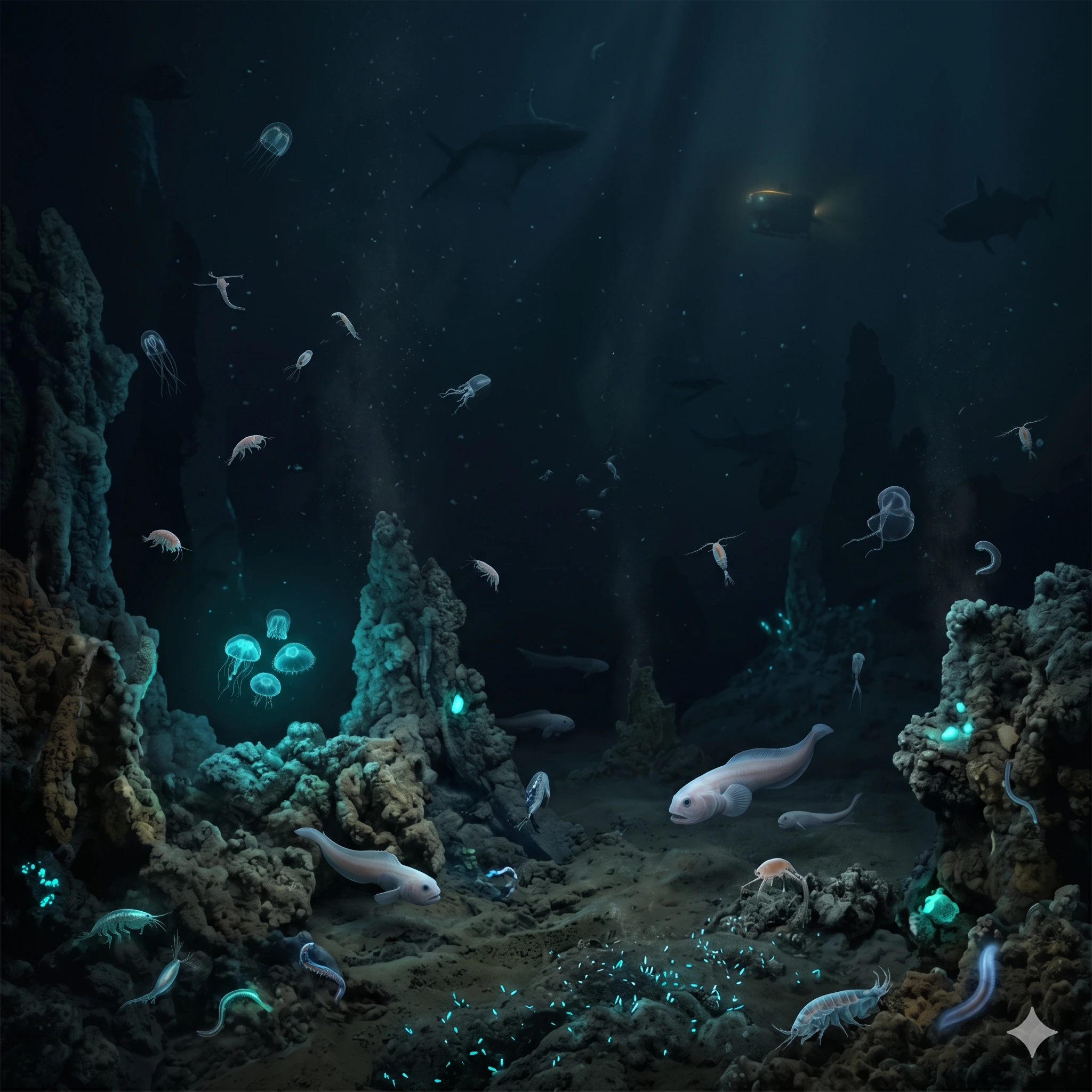
What lives in the Mariana Trench? More than empty darkness. Earth’s deepest ocean trench contains
pressure-adapted fish, amphipods, microbes, sea cucumbers, worms and fragile organisms that survive where
sunlight disappears completely.
The Mariana Trench sounds like a place where life should not work. It is dark, cold, remote and crushed by
pressure so intense that ordinary animals would collapse. At its deepest known region, Challenger Deep, the
trench reaches nearly 11 kilometers below the ocean surface. That is deeper than Mount Everest is tall.
And yet the trench is not dead. Life is there — not in the colorful coral-reef sense, not in the familiar
surface-ocean sense, but in a stranger, slower and more pressure-built form. The animals and microbes that survive
in the hadal zone are not mistakes. They are specialists.
To understand life in the Mariana Trench, we need to stop imagining the deep sea as a single empty basement.
The deep ocean has zones, gradients, cliffs, sediments, slopes, food pulses and biological communities. The trench
is not just a hole. It is a landscape.
The Mariana Trench is not a lifeless pit. It is a pressure-built ecosystem where biology rewrites its own limits.
This article explores what actually lives there, why survival is so difficult, how animals adapt to pressure and why
the deepest ocean is one of the most important frontiers on Earth.
Why the Mariana Trench is so extreme
The Mariana Trench sits in the western Pacific Ocean, where one tectonic plate dives beneath another. This subduction
process creates one of the deepest seafloor features on Earth. Its deepest area, Challenger Deep, reaches roughly
11,000 meters below sea level.
The problem for life is not just depth. It is the combination of depth, darkness, pressure, cold and scarcity. Sunlight
cannot reach the hadal zone. Photosynthesis is not the foundation of life there in the same way it is near the surface.
Food often arrives as “marine snow” — tiny organic particles drifting downward — or as occasional larger falls from
above.
Pressure is the most famous challenge. NOAA explains that water pressure increases by about one atmosphere every
10 meters of depth. At the deepest part of the Mariana Trench, pressure can be around a thousand times the standard
atmospheric pressure at sea level. :contentReference[oaicite:1]{index=1}
The hadal zone, named after Hades, is generally used for ocean depths from about 6,000 to 11,000 meters. WHOI describes
it as a world of extreme depth and pressure, temperatures just above freezing and complete darkness from sunlight.
:contentReference[oaicite:2]{index=2}
The Mariana Trench is not hard for life because one thing is extreme. It is hard because everything is extreme at once.
7 creatures and life forms found in the Mariana Trench
Life in the Mariana Trench is not dominated by large familiar animals. The deeper you go, the more the ecosystem shifts
toward small, soft-bodied, pressure-adapted organisms and microbes. Some species are known from direct observation,
baited landers, submersibles or recovered samples. Others are known from broader hadal research and related trench
environments.
1. Mariana snailfish
The Mariana snailfish is one of the most famous deep-trench animals. Snailfishes are soft-bodied, pale and adapted to
extreme pressure. Nature research describes liparid snailfishes as highly successful hadal fishes, found in multiple
trenches and reaching depths beyond 8,100 meters. :contentReference[oaicite:3]{index=3}
NOAA reports that the deepest confirmed fish sighting is a snailfish filmed at 8,336 meters, and notes that fish likely
cannot live much deeper than about 8,400 meters because of pressure-related physiological limits. :contentReference[oaicite:4]{index=4}
That means the very deepest parts of Challenger Deep may be beyond the practical lower limit for fish.
2. Hirondellea gigas amphipods
Amphipods are small crustaceans, and in the trench they can be surprisingly important. Some hadal amphipods are scavengers,
arriving quickly at baited landers. Their role is crucial because food in the deep trench is unpredictable. When organic
matter reaches the seafloor, scavengers help recycle it into the ecosystem.
Hirondellea gigas is one of the amphipods associated with the Mariana Trench. These animals may look small compared with
surface predators, but in the hadal world they are energetic responders to rare food opportunities.
3. Xenophyophores
Xenophyophores are giant single-celled organisms found in deep-sea environments, including hadal settings. They may look
like delicate seafloor structures rather than animals, but they are living organisms. Their existence reminds us that
“life” in the deep ocean is not always shaped like fish, crabs or worms.
These organisms can form fragile structures on the seafloor and may create microhabitats for other tiny creatures.
In a place where large animals are rare, small structures can matter.
4. Microbes
Microbial life is one of the most important parts of the deep ocean. Microbes can live in sediments, process organic
matter and participate in chemical cycles. Some deep ecosystems depend heavily on microbial activity because sunlight-driven
photosynthesis is absent.
In the Mariana Trench, microbes may help recycle nutrients from sinking organic particles and seafloor sediments. They are
not dramatic in the way a giant squid is dramatic, but biologically they may be more important than many larger animals.
5. Sea cucumbers and holothurians
Sea cucumbers are common deep-sea animals in many abyssal and hadal environments. They feed on organic material in
sediments, essentially processing the seafloor. Their bodies are soft, flexible and adapted to life under pressure.
In the deep ocean, sea cucumbers are part of the quiet machinery of the seafloor. They turn sediment into food and help
connect falling organic material to the wider ecosystem.
6. Polychaete worms
Polychaete worms are marine segmented worms, and some are found in deep-sea sediments. In trench environments, worm-like
animals may live in or on the seafloor, feeding on detritus, microbes or small prey.
They are not the headline creatures of the trench, but they matter because sediments are habitats. The trench floor is not
just a flat empty surface; it is a layered world where tiny animals can burrow, feed and hide.
7. Translucent deep-sea animals and jelly-like life
Many deep-sea organisms are translucent, soft or gelatinous. In darkness, bright colors are often less useful than they
are in shallow water. Soft bodies may also be better suited to pressure than hard gas-filled structures.
Jellyfish-like animals, delicate swimmers and other translucent organisms may appear alien to us because they evolved
in a world with different rules: no sunlight, immense pressure and sparse food. They are not primitive. They are adapted.
How animals survive crushing pressure
Pressure affects biology at the molecular level. It can change how proteins fold, how cell membranes behave and how
enzymes work. Animals living in the hadal zone need bodies and biochemistry that continue functioning under forces that
would destroy surface-adapted life.
One obvious adaptation is the absence of gas-filled spaces. Animals with large air cavities would have a problem under
extreme pressure. Deep-sea animals often have soft, watery tissues, flexible bodies and biochemical adaptations that help
keep proteins and membranes stable.
For snailfish, researchers have studied anatomical and genomic features associated with life in extreme depths.
The broader lesson is that survival is not one trick. It is a package: body shape, chemistry, metabolism, reproduction
and behavior all tuned to the hadal environment.
Surface
Step 1:
Sunlight is abundant. Photosynthesis powers most food webs directly or indirectly.
The deepest animals do not conquer pressure by resisting it like a submarine. They survive by being built for it. Their
cells, tissues and lifestyles are shaped around conditions that would be catastrophic for surface life.
Hadal animals do not fight the deep ocean. They become compatible with it.
Why sunlight cannot reach the Mariana Trench
Sunlight fades quickly in seawater. Red wavelengths disappear first, then other colors vanish as depth increases.
By the time you reach the deep ocean, sunlight is gone. The Mariana Trench is far below the reach of the sun.
Without sunlight, there is no photosynthesis by plants or algae in the trench itself. That changes the food web.
Instead of fresh sunlight-powered production, much of the food arrives from above as falling organic material:
dead plankton, particles, fecal pellets, carcasses and other debris.
This falling food is often called marine snow. It is not snow in the winter sense, but it drifts downward like flakes
through the water column. By the time it reaches hadal depths, it may be limited and patchy, which is why many deep-sea
organisms are adapted to scarcity.
| Feature | Surface ocean | Mariana Trench |
|---|---|---|
| Light | Sunlight powers photosynthesis. | No sunlight reaches the hadal depths. |
| Pressure | Low compared with deep sea. | Up to roughly 1,000× surface pressure. |
| Food | Often produced locally by photosynthesis. | Mostly falls from above or comes from microbial processes. |
| Animals | Many familiar fish, reefs and plankton systems. | Pressure-adapted fish, amphipods, microbes and benthic life. |
Darkness also changes communication. In many deep-sea environments, bioluminescence becomes important. Light can be used
to attract prey, confuse predators, find mates or signal. In the deepest trench environments, visual systems and light
production may vary, but the absence of sunlight defines the world.
What humans have found in the Mariana Trench
The Mariana Trench is difficult to explore because the environment is hostile to both humans and machines. Any vehicle
that descends there must survive crushing pressure, darkness, cold and communication challenges. That is why much of the
trench is still poorly known compared with land environments.
Scientists use submersibles, remotely operated vehicles, autonomous vehicles and baited landers to study hadal life.
Baited landers are especially useful because scavengers such as amphipods may approach them, allowing researchers to
film or collect specimens from extreme depths.
Exploration has revealed that the deepest ocean is not empty. It contains specialized animals, microbial communities,
sediment ecosystems and signs of human impact. Even places that feel beyond civilization can contain pollution, plastic
or chemical traces transported by the ocean.
The Mariana Trench is not unexplored because it is boring. It is unexplored because reaching it is technically brutal.
Every descent is a reminder that Earth still has frontiers. We have mapped planets, photographed galaxies and sent probes
beyond the outer planets, yet parts of our own ocean remain less familiar than the surface of the Moon.
Why the deepest ocean still matters
The Mariana Trench matters because it expands the definition of where life can exist. If animals and microbes can survive
under crushing pressure, near-freezing temperatures and permanent darkness, then biology is more flexible than everyday
experience suggests.
That matters for Earth science, climate science, evolution and even astrobiology. Extreme environments help scientists ask
whether life might survive in hidden oceans elsewhere, such as beneath the icy surfaces of moons. The trench is not space,
but it is one of the places on Earth that makes biology feel cosmic.
The trench also matters because it is vulnerable. Deep-sea ecosystems may be slow-growing and difficult to recover if damaged.
Pollution can reach deep water. Future deep-sea mining and expanding human activity raise questions about how to protect
ecosystems we barely understand.
The Mariana Trench is not where life disappears. It is where life becomes quiet, strange and almost impossible — then survives anyway.
So, what lives in the Mariana Trench? Not monsters in the mythical sense, but organisms more impressive than monsters:
animals and microbes built for a world that should feel impossible. The trench is Earth’s reminder that life does not
need comfort. Sometimes, it only needs a narrow opening in the dark.
Knowledge check
Depth ladder
From sunlight to hadal dark
A conceptual dive from the surface photic zone toward Challenger Deep scales.
-
0–200 m
SunlitPhotosynthesis fuels most familiar marine food webs.
-
Twilight
MesopelagicLight fades; many animals migrate vertically.
-
Midnight
BathypelagicPerpetual dark; sparse food falls from above.
-
Abyssal
Abyss plainsCold seafloor communities on vast plains.
-
Hadal
TrenchDeepest trenches — extreme pressure, specialized life.
FAQ: What lives in the Mariana Trench?
What animals live in the Mariana Trench?
Known life includes Mariana snailfish, amphipods, microbes, sea cucumbers, worms and other deep-sea organisms
adapted to darkness, cold and extreme pressure.
Can fish live at the bottom of the Mariana Trench?
Fish such as snailfish live at extreme depths, but research suggests there may be a lower depth limit for fish
near about 8,400 meters because of pressure-related biology. The deepest parts may be too extreme for fish.
Is there sunlight in the Mariana Trench?
No. The hadal depths of the Mariana Trench are far below the reach of sunlight. Life there depends on food falling
from above, scavenging and microbial processes.
Why is the Mariana Trench hard to explore?
Extreme pressure, darkness, depth, cold and technical limitations make exploration difficult. Vehicles must be
specially designed to survive the hadal zone.
-
NOAA Ocean Explorer —
What is the deepest-living fish?
. -
NOAA Ocean Explorer —
Wild and Bizarre Marine Life
. -
Woods Hole Oceanographic Institution —
Hadal Zone
. -
Wang, K. et al., Nature Ecology & Evolution —
Morphology and genome of a snailfish from the Mariana Trench
. -
Natural History Museum —
Deepest-ever fish filmed at a depth of 8,336 metres
. -
Woods Hole Oceanographic Institution —
Study life in ocean’s greatest depths
.
Editorial note: This article was created through Mindivr’s editorial process: topic research, source review,
visual explanation design and human editing. If you spot an error, please use the contact page.
The Edge of the Observable Universe
Explore the cosmic horizon and why the universe may continue beyond what we can see.
Where Do Dinosaurs Sleep?
Discover fossil sites that preserve ancient worlds, nests, tracks and deep time.
Can AI Discover New Laws of Physics?
How machine learning may help reveal hidden physical patterns.
Get one science mystery and one puzzle every week.
Join Mindivr for interactive science articles, visual explanations and curiosity-first science stories.
If this article made you curious, support the next one.
Mindivr is built for premium visual science explanations. Your support helps create more interactive articles,
diagrams and science puzzles.


Join the conversation
Share a thoughtful question, correction, or insight. Keep it civil and evidence-aware.