
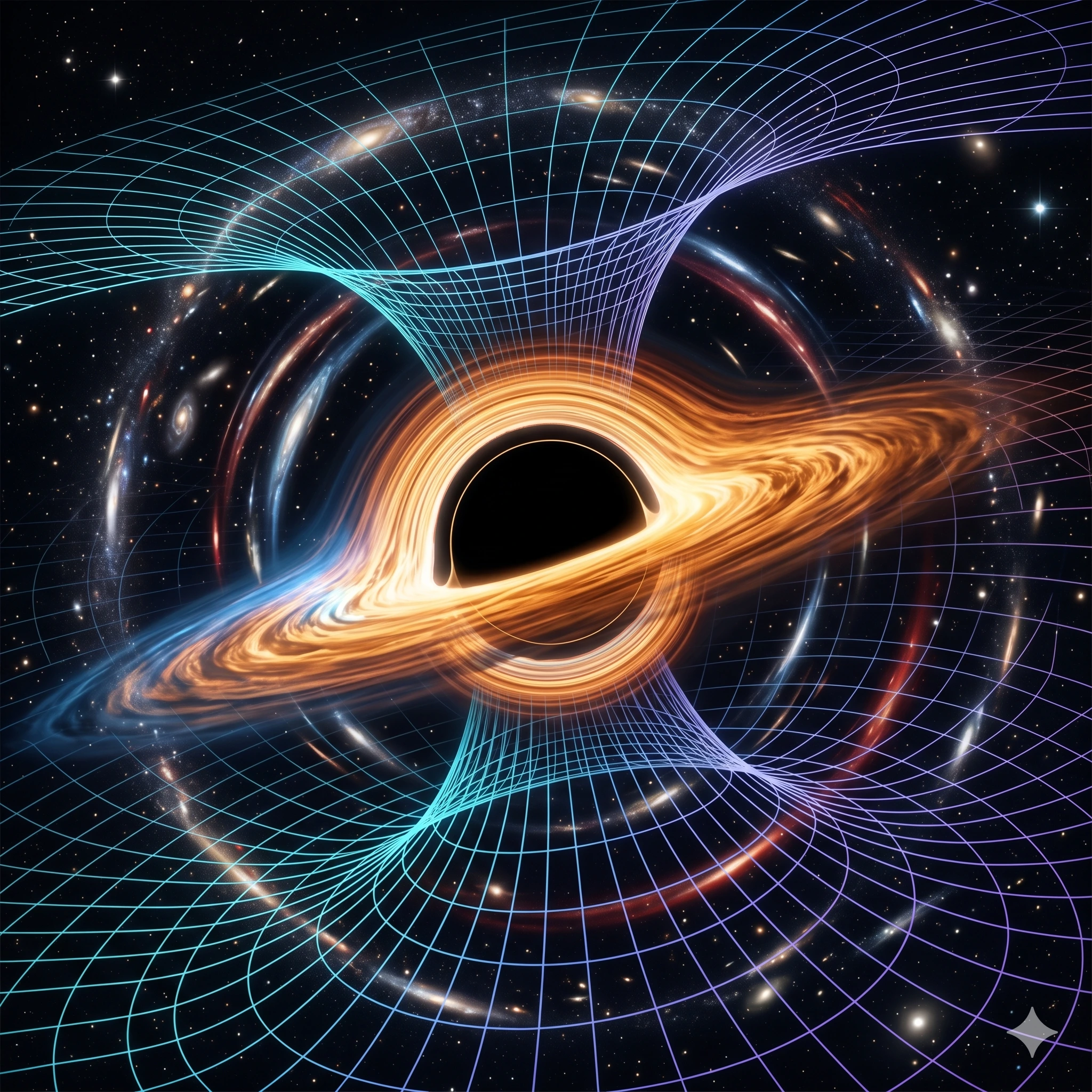
Black holes explained without sci-fi: they are not portals, monsters, or magical drains in space. They are extreme gravitational regions where spacetime bends so strongly that, past a boundary called the event horizon, not even light can escape.
A black hole is a region of spacetime where gravity makes escape impossible after the event horizon. Far away, its pull depends mainly on mass — like any other object with the same mass. The sci-fi “vacuum cleaner” picture is wrong; the real story is extreme geometry, careful observation, and unfinished physics at the deepest interior.
What is a black hole?
A black hole is a region where mass has been compressed into such a small volume that the escape velocity exceeds the speed of light. Escape velocity is the speed needed to leave an object’s gravitational pull. On Earth, a rocket must reach about 11.2 kilometers per second to escape. Near a black hole, the required escape speed becomes impossible because nothing can travel faster than light.
Black holes are predicted by general relativity, Einstein’s theory of gravity. In that framework, gravity is not only a force pulling objects together. Gravity is the curvature of spacetime caused by mass and energy. A black hole is an extreme case of that curvature.
The defining feature is the event horizon. It is not a physical surface like the ground. You could cross it without hitting a wall — especially if the black hole were very large — but after crossing, returning becomes impossible.
Black holes can form when massive stars collapse at the end of their lives. They can also exist as supermassive black holes at the centers of galaxies, with masses millions or billions of times greater than the Sun. Scientists still study how the largest ones grew so early in cosmic history.
A black hole is what happens when gravity wins so completely that all escape routes point inward.
Knowledge check
The event horizon: the point of no return
The event horizon is the black hole’s defining boundary — the point beyond which signals cannot escape to the outside universe. It is not made of material and does not glow by itself. It is a boundary in causality: the region where the future of anything crossing it points inward.
“Point of no return” is useful, but it can still mislead. For a large black hole, an astronaut crossing the horizon might not feel anything special at that exact moment. The danger comes from what happens next: all possible routes lead deeper.
This differs from ordinary escape problems. A rocket can leave Earth if it has enough speed. Past the horizon, even light has no outward path. The structure of spacetime itself has changed which directions are possible.
When black holes are imaged, we are not seeing a black-hole “surface.” We see glowing matter and light distorted around it. The dark central region is a shadow produced by the black hole’s gravity and event horizon.
Compare the zones
Interactive black hole boundary
A conceptual walk from far away to the region where escape becomes impossible. These are teaching zones, not a precise flight plan.
-
Far away
Zone 1Gravity can be strong, but escape is still possible with enough energy. At large distances, mass dominates the influence — not “suction.”
-
Closer
Zone 2Orbits and light paths become more strongly bent. Extreme effects grow, but signals can still leave the region.
-
Near horizon
Zone 3Time dilation and redshift become extreme for distant observers. Crossing remains possible for an infalling traveler, but escape becomes ever harder.
-
Event horizon
Zone 4The causal boundary: after this point, no signal can reach the outside universe. It is not a solid wall.
-
Inside
Zone 5Every possible future path leads deeper inward. What the deepest interior truly is remains an open theoretical problem.
Why black holes are not vacuum cleaners
The vacuum-cleaner myth is one of the biggest misunderstandings about black holes. A black hole does not reach across the universe and pull everything in. Gravity still weakens with distance. Far away, a black hole’s gravitational influence depends mostly on its mass, just like any other object.
If you replaced the Sun with a black hole of the same mass, Earth would not be sucked in. The solar system would become dark and frozen without sunlight, but Earth’s orbit would remain almost the same because the mass at the center would be the same. The danger comes from getting close enough for extreme gravity and tidal forces to dominate.
Tidal forces happen because gravity is stronger on the side of an object closer to the black hole than on the side farther away. Near small black holes, that difference can stretch matter violently — sometimes called spaghettification.
| Myth | Reality |
|---|---|
| Black holes suck in everything | They attract through gravity, but distance still matters. |
| A black hole is a physical hole | It is a region of spacetime with an event horizon. |
| Crossing the horizon always feels dramatic | For large black holes, the horizon crossing itself may not feel special locally. |
| Black holes are imaginary | They are supported by stellar orbits, gravitational waves, X-rays, and direct imaging. |
Black holes explained without sci-fi are more impressive, not less. They do not need magical sucking power. Ordinary gravity, taken to its extreme limit, is already strange enough.
What happens to time near a black hole?
General relativity says gravity affects time. The stronger the gravitational field, the slower time passes relative to a distant observer. This effect is called gravitational time dilation. It is not just a movie idea — it is real physics.
Near a black hole, time dilation becomes extreme. To a distant observer, an object falling toward the event horizon appears to slow down and fade as its light becomes redshifted. From the falling object’s own perspective, however, it crosses the horizon in a finite amount of time.
That split between perspectives is one reason black holes are conceptually difficult. There is no single universal clock for everyone. Time depends on gravity and motion. Near a black hole, that dependence becomes impossible to ignore.
To someone far away, falling matter appears to slow and redden near the horizon. To the falling observer, the journey continues inward.
Movies often exaggerate, but the core idea that gravity changes time is real. Even GPS satellites must account for relativistic time effects — far weaker than anything near a black hole, yet precise enough to matter for navigation.
What is inside a black hole?
This is where physics becomes uncertain. General relativity predicts that inside a black hole, collapse leads toward a singularity: a region where density and curvature become infinite in the mathematical description. But infinities often signal that a theory has reached its limit.
Most physicists do not treat “singularity” as a complete description of the interior. It likely means general relativity is incomplete at extremely small scales and extreme gravity. Understanding the deepest interior may require a theory of quantum gravity — a framework combining general relativity with quantum mechanics.
That is one reason black holes are not just astronomical objects. They are theoretical laboratories. They force the two great pillars of modern physics — relativity and quantum theory — into the same room.
The event horizon is well-defined in relativity. The deepest interior is where our best theories may stop being complete.
In other words, black holes are understood enough to be observed, modeled, and predicted — but not so completely that the mystery is gone. The outside is astronomy. The inside is a frontier.
Types of black holes
Not all black holes are the same size. Scientists usually discuss several broad categories based mainly on mass.
Stellar-mass black holes
These can form when massive stars collapse after exhausting their nuclear fuel. They may have several to tens of solar masses. Many are found in binary systems, where they pull matter from a companion star and produce X-rays.
Intermediate-mass black holes
These are more mysterious. They would be heavier than stellar-mass black holes but lighter than supermassive black holes. Evidence for them exists, but they are harder to find and study.
Supermassive black holes
These live at the centers of many large galaxies. The Milky Way’s central black hole, Sagittarius A*, has about four million solar masses. Other galaxies contain black holes with masses reaching billions of Suns.
Primordial black holes?
Some theories suggest black holes could have formed in the early universe from density fluctuations rather than from stars. These primordial black holes remain hypothetical and are still under investigation.
| Type | Approximate mass | Where found |
|---|---|---|
| Stellar-mass | Several to tens of Suns | Collapsed massive stars, binary systems |
| Intermediate-mass | Hundreds to thousands of Suns | Candidate objects in clusters and galaxies |
| Supermassive | Millions to billions of Suns | Centers of large galaxies |
| Primordial | Hypothetical range | Possible early-universe formation |
How do we know black holes are real?
We cannot see black holes directly because they emit no light from inside the event horizon. But we can observe their effects. Astronomers detect black holes through the motion of stars, X-rays from hot accreting gas, gravitational waves from mergers, and images of black-hole shadows.
At the center of the Milky Way, stars orbit an invisible massive object called Sagittarius A*. Their orbits reveal a compact object with millions of solar masses. This evidence was central to the 2020 Nobel Prize in Physics, awarded partly for the discovery of a supermassive compact object at the galactic center.
In 2015, LIGO detected gravitational waves from two merging black holes — the first direct detection of gravitational waves and a spectacular confirmation that black-hole mergers occur in the real universe.
In 2019, the Event Horizon Telescope released the first image of a black-hole shadow, from the galaxy M87. In 2022, it released an image of Sagittarius A*, the black hole at the center of our galaxy.
Black holes are supported by multiple independent lines of evidence: stellar motion, accretion radiation, gravitational waves, and horizon-scale imaging.
What black holes teach us about reality
Black holes teach us that gravity is not just a pull. It is geometry. Space and time are not passive backgrounds; they can bend, stretch, and form horizons. Near a black hole, the universe reveals that “where” and “when” are deeper than everyday intuition suggests.
They also teach humility. We can predict orbits around black holes, detect their mergers, and image their shadows — yet still not fully understand what happens at the deepest interior. Black holes are both known and unknown, measured and mysterious.
This makes them powerful scientific objects. They are places where relativity, quantum mechanics, thermodynamics, and information theory collide. Questions about black hole entropy, Hawking radiation, and the information paradox remain central to theoretical physics.
Black holes are not where physics becomes fake. They are where physics becomes brutally honest about its limits.
Black holes explained without sci-fi are not less mysterious. They are more mysterious. The real version does not need portals, monsters, or cosmic magic. Gravity, when pushed to its extreme, is already one of the strangest things the universe can do.
Final check
FAQ: Black holes explained
What is a black hole in simple terms?
A black hole is a region of spacetime where gravity is so strong that nothing can escape after crossing the event horizon.
Do black holes suck in everything?
No. Black holes attract through gravity like other massive objects. They are only unavoidable if something crosses the event horizon.
Can light escape a black hole?
Light can escape from outside the event horizon, but not from inside it. That is why the event horizon defines the black hole boundary.
Are black holes proven to exist?
Strong evidence supports black holes, including stellar orbits, X-rays from accretion, gravitational waves, and Event Horizon Telescope images.
Sources and references
- NASA Science — Black Holes.
- NASA Universe — Types of black holes.
- Event Horizon Telescope — First image of a black hole.
- Event Horizon Telescope — First image of Sagittarius A*.
- LIGO Caltech — Gravitational-wave detection papers.
- Nobel Prize — The Nobel Prize in Physics 2020.
Editorial note: This article was created through Mindivr’s editorial process: topic research, source review, visual explanation design, and human editing. If you spot an error, please use the contact page.


Join the conversation
Share a thoughtful question, correction, or insight. Keep it civil and evidence-aware.